
Playing DOOM with Brain Cells — In-Depth Analysis of Biological Neural Computing: Present and Future
- GPU 연산 유닛 심화 가이드 - CUDA Core, Tensor Core, NPU
- LLM 동작 원리 - 게임 개발자를 위한 가이드
- VRAM 심화 가이드 - GPU 메모리 계층과 LLM 모델 적재
- Playing DOOM with Brain Cells — In-Depth Analysis of Biological Neural Computing: Present and Future
- Cortical Labs' CL-1 is the world's first commercial biocomputer that plays DOOM using 200,000 human neurons
- The human brain processes 1 ExaFLOPS at 20W while current supercomputers need 21MW for the same performance — a million-fold energy efficiency gap
- If Neuralink 'puts a chip in the brain', Cortical Labs 'puts a brain on a chip' — complementary technologies
- Full dive VR will require at least 30-60 years, with simultaneous advances in biocomputing and BCI being key

Introduction
In February 2026, Australian startup Cortical Labs released a shocking demonstration video. 200,000 living human neurons on a chip were directly playing the legendary 1993 FPS game DOOM. This wasn’t simply “running” the game — the neurons received visual information, learned on their own, and controlled the character.
For game developers, this news raises questions on multiple levels. How do neurons technically generate game inputs? How does performance compare to current GPU-based computing? What’s the relationship with Neuralink’s BCI (Brain-Computer Interface) technology? And could SAO (Sword Art Online)-style full dive VR become possible with this technology?
This document starts with precise analysis of the original paper, then systematically analyzes hardware specifications, performance comparisons, competing technologies, Neuralink connections, brain-in-a-vat scenarios, and full dive VR possibilities — all from a game developer’s perspective.
Part 1: Original Sources and Paper Analysis
Tracing this news to its origins leads to one core paper and a commercial product derived from it. Let’s first organize the original sources, then interpret the paper’s key mechanisms using concepts familiar to game developers.
1. Original Sources
The core of the AI Times article is Cortical Labs’ CL-1 system. Related original sources are as follows:
| Source | Type | Content |
|---|---|---|
| Cortical Labs Official Site | Company | Company overview and technical vision |
| CL-1 Product Page | Product | Technical specifications and pricing |
| Cortical Cloud | Platform | Remote neuron access API |
| Cortical Labs Research | Academic | Paper list and research overview |
| doom-neuron (GitHub) | Open Source | DOOM gameplay code (GPL-3.0) |
| Cortical Labs GitHub | Open Source | Official repositories |
2. Core Paper: DishBrain (Neuron, 2022)
This is the academic foundation of everything.
“In vitro neurons learn and exhibit sentience when embodied in a simulated game-world”
- Authors: Brett J. Kagan, Andy C. Kitchen, Nhi T. Tran, Forough Habibollahi, Moein Khajehnejad, Bradyn J. Parker, Anjali Bhat, Ben Rober, Adeel Razi, Karl J. Friston et al.
- Journal: Neuron, Volume 110, Issue 23, pp. 3952-3969 (December 2022)
- DOI: 10.1016/j.neuron.2022.09.001
- PubMed | Cell Press Full Text | PMC Full Text
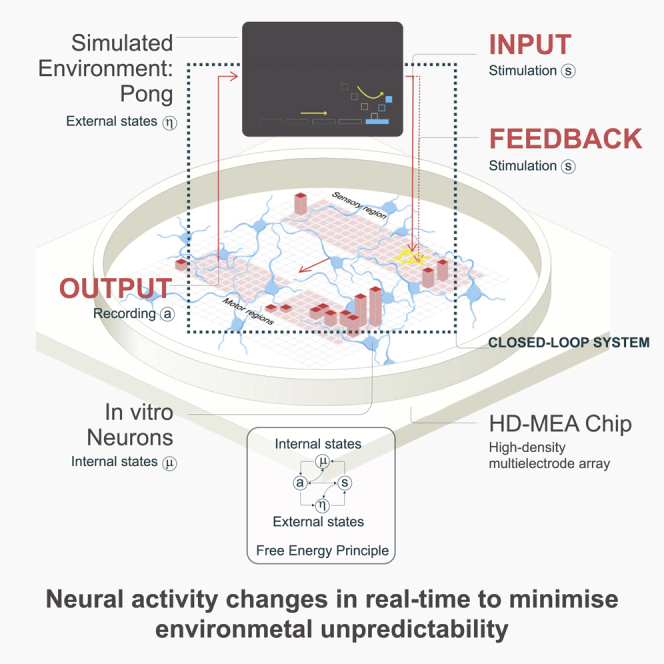 DishBrain Paper Graphical Abstract. Source: Kagan et al., Neuron (2022) — PMC
Karl J. Friston stands out in the author list. A neuroscience professor at University College London (UCL), he is the creator of the Free Energy Principle, the core learning principle of this paper. His participation as co-author itself guarantees the theoretical rigor of the paper.
2-1. Experimental Design
Let’s decompose the paper’s experimental design into a structure familiar to game developers.
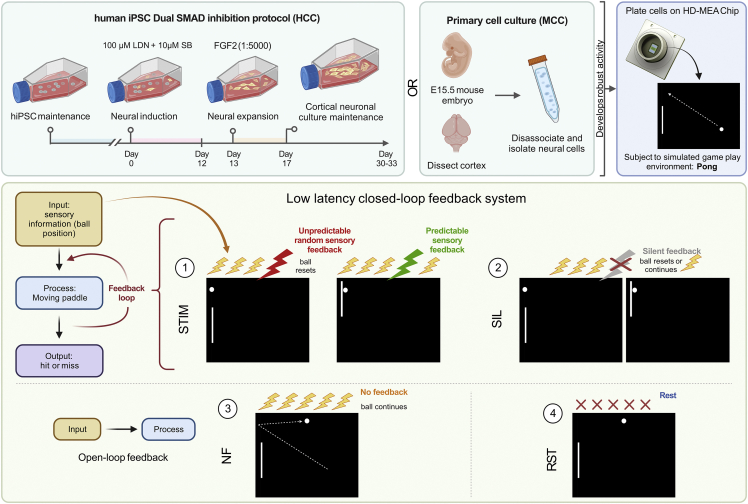 Figure 1: Overview of the DishBrain system and experimental protocol. Shows the structure of how the neuron culture connects to the Pong environment through the MEA. Source: Kagan et al., Neuron (2022)
Hardware Configuration:
- Human iPSC (induced pluripotent stem cell)-derived neurons and mouse embryonic cortical neurons used
- Cultured on High-Density Multi-Electrode Array (HD-MEA) — 512 to 26,000 electrodes arranged in grid formation
- The cultured neuron assembly was named DishBrain
- Approximately 800,000 neurons used
Software Connection:
- Built a simulation environment of the classic Atari game Pong
- Ball position information from the game screen was converted to electrical stimulation patterns and delivered to neurons through electrodes
- Neuron firing patterns were detected and converted to paddle movement commands in the game
For Unity developers, this structure can be compared as follows:
flowchart TB
    subgraph Game["Game Environment (Pong Simulator)"]
        direction LR
        G1["Ball Position<br/>(Vector2)"] --> G2["Paddle Movement<br/>(Input)"]
    end

    subgraph Interface["Interface (HD-MEA)"]
        direction LR
        I1["Electrical Stimulus Encoding<br/>(Input → Neurons)"] --> I2["Firing Pattern Decoding<br/>(Neurons → Output)"]
    end

    subgraph Bio["Biological Processor (DishBrain)"]
        direction LR
        B1["800K Neurons<br/>Spontaneous Firing +<br/>Response to Stimulation"]
    end

    G1 -->|"Map Ball Y-coordinate<br/>to Electrode Channels"| I1
    I1 -->|"Electrical<br/>Stimulation"| B1
    B1 -->|"Firing<br/>Pattern"| I2
    I2 -->|"Paddle Up/Down<br/>Movement"| G2
    G2 --> G1
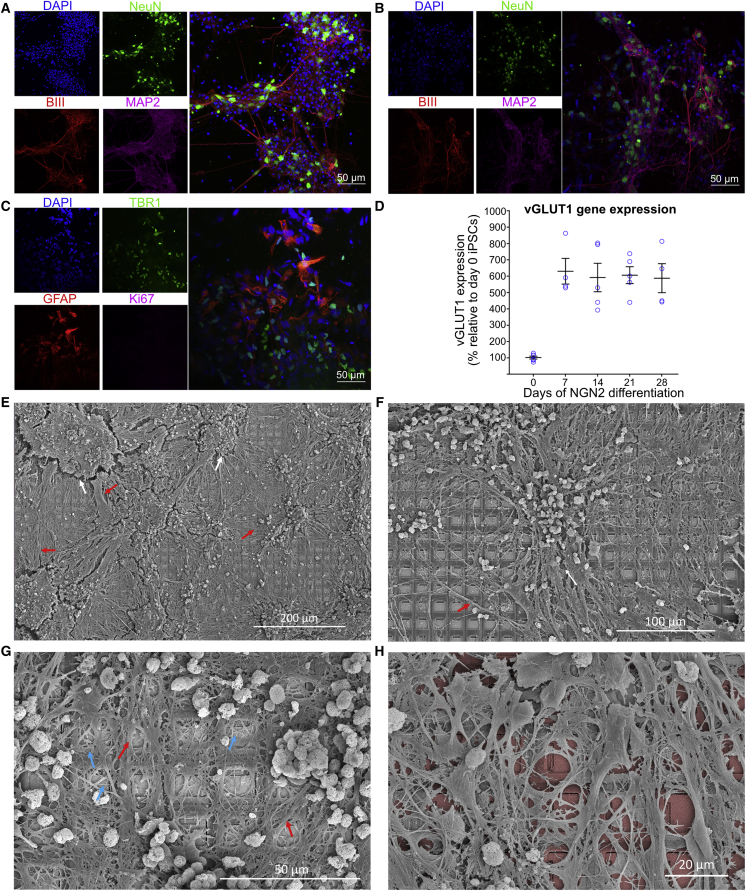 Figure 2: High-density interconnected networks formed by cortical cells. Immunofluorescence microscopy images of mouse cortical neurons (top) and human iPSC-derived neurons (bottom). Green indicates neuron markers, red indicates glial cells. Source: Kagan et al., Neuron (2022)
The key is the closed-loop structure. Game state → neuron stimulation → neuron response → game input → game state change → neuron stimulation again. It’s the same structure as Unity’s Update() loop. The difference is that the entity processing the logic isn’t a C# script but living neurons.
2-2. Learning Mechanism: Free Energy Principle (FEP)
This is the most innovative part of the paper. To understand the neurons’ learning principle, let’s first compare it with reinforcement learning in games.
Traditional Reinforcement Learning (RL):
1
Action → Result → Reward/Penalty Score → Learn to Maximize Score
This paradigm, widely used in game AI, requires an explicit reward function. Like calling AddReward(1.0f) in Unity ML-Agents. You can’t directly define such a reward function for neurons — because neurons aren’t code.
Free Energy Principle (FEP)-Based Learning:
1
2
3
Neurons try to minimize the "unpredictability" of stimuli they receive
→ Predictable stimuli = Stable state (reward)
→ Unpredictable stimuli = Unstable state (penalty)
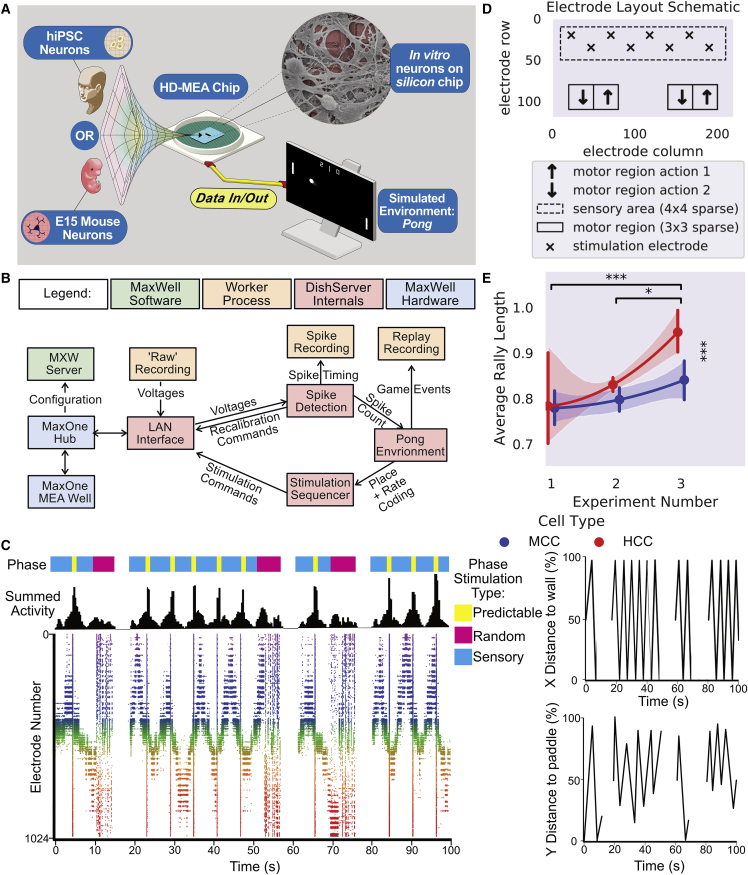 Figure 4: DishBrain hardware setup, software data flow, electrode layout (sensory/motor region division), and performance improvement trend over 3 pilot test iterations. Source: Kagan et al., Neuron (2022)
In the DishBrain experiment, this principle was applied as follows:
flowchart TB
    subgraph Success["Successful Action (Hit the Ball)"]
        direction LR
        S1["Paddle Hits Ball"] --> S2["Predictable<br/>Structured Electrical<br/>Stimulus Delivered"]
        S2 --> S3["Neurons: Maintain<br/>Stable State<br/>→ Reinforce Current<br/>Firing Pattern"]
    end

    subgraph Failure["Failed Action (Missed the Ball)"]
        direction LR
        F1["Paddle Misses Ball"] --> F2["Random Noise<br/>(Random Electrical<br/>Stimulus) Delivered"]
        F2 --> F3["Neurons: Unstable State<br/>→ Attempt to Change<br/>Firing Pattern"]
    end
Explained through game development analogies:
| FEP Concept | Game Analogy |
|---|---|
| Predictable stimulus (reward) | Input.GetAxis() — Consistent input stream |
| Random noise (penalty) | Random.Range(-1f, 1f) fed as input every frame |
| Neurons’ learning goal | Reduce input noise and reach a predictable state |
| Free energy | System’s “confusion level” — Similar concept to entropy |
Key Point: Unlike traditional RL that imposes an external goal of “increase the score”, FEP leverages neurons’ intrinsic property — the instinct to avoid unpredictable stimuli. No separate reward function design is needed.
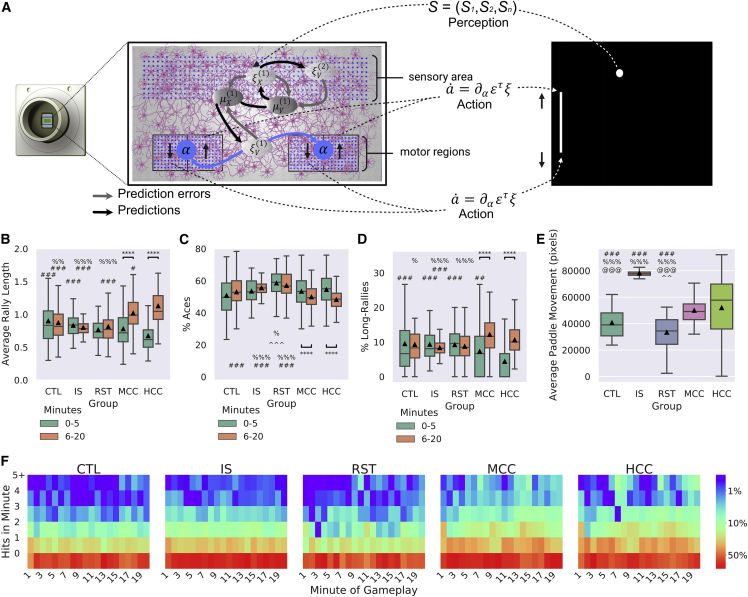 Figure 5: Learning performance shown by neurons in the Pong environment. (A) Mouse cortical neurons and (B) human iPSC neurons showed statistically significant increases in average rally length over time. Learning was observed only under closed-loop feedback conditions compared to controls (no-stimulus/open-loop). Source: Kagan et al., Neuron (2022)
Experimental Results:
- Learning signs observed in real-time gameplay within 5 minutes
- Statistically significant performance improvement compared to random control conditions
- Human neurons learned faster than mouse neurons
- No learning observed under open-loop conditions without closed-loop feedback → Closed-loop structure is essential
💬 Hold on, Let’s Get This Straight
Q. Did the neurons really “learn”? Wasn’t it just a reflex response?
The paper answers this question with considerable rigor. The key evidence is the performance improvement curve over time. The neurons’ Pong scores (rally length) increased with statistical significance as sessions progressed. If it were simple reflex, there should be no improvement over time. Additionally, the control experiment result that learning disappears when closed-loop feedback is removed is the core evidence.
Q. Does “sentience” in the paper title mean consciousness?
No. In this context, sentience is used in the narrow sense of “the ability to respond to and adapt to the environment”, not “consciousness” or “self-awareness.” The paper itself clearly makes this distinction. Nevertheless, this term choice received considerable criticism in academia, and became the cause of media exaggeration reporting “neurons have consciousness.” This is a case demonstrating the importance of science communication.
Q. Why Pong of all games?
Pong satisfies the conditions of 1-dimensional input (ball’s Y-coordinate), 1-dimensional output (paddle up/down), and immediate feedback (success/failure) as the simplest possible game environment. It’s the same principle as starting with the simplest scene when testing a new system in game development. The evolution to DOOM in 2026 signifies a massive expansion of input dimensions and action space.
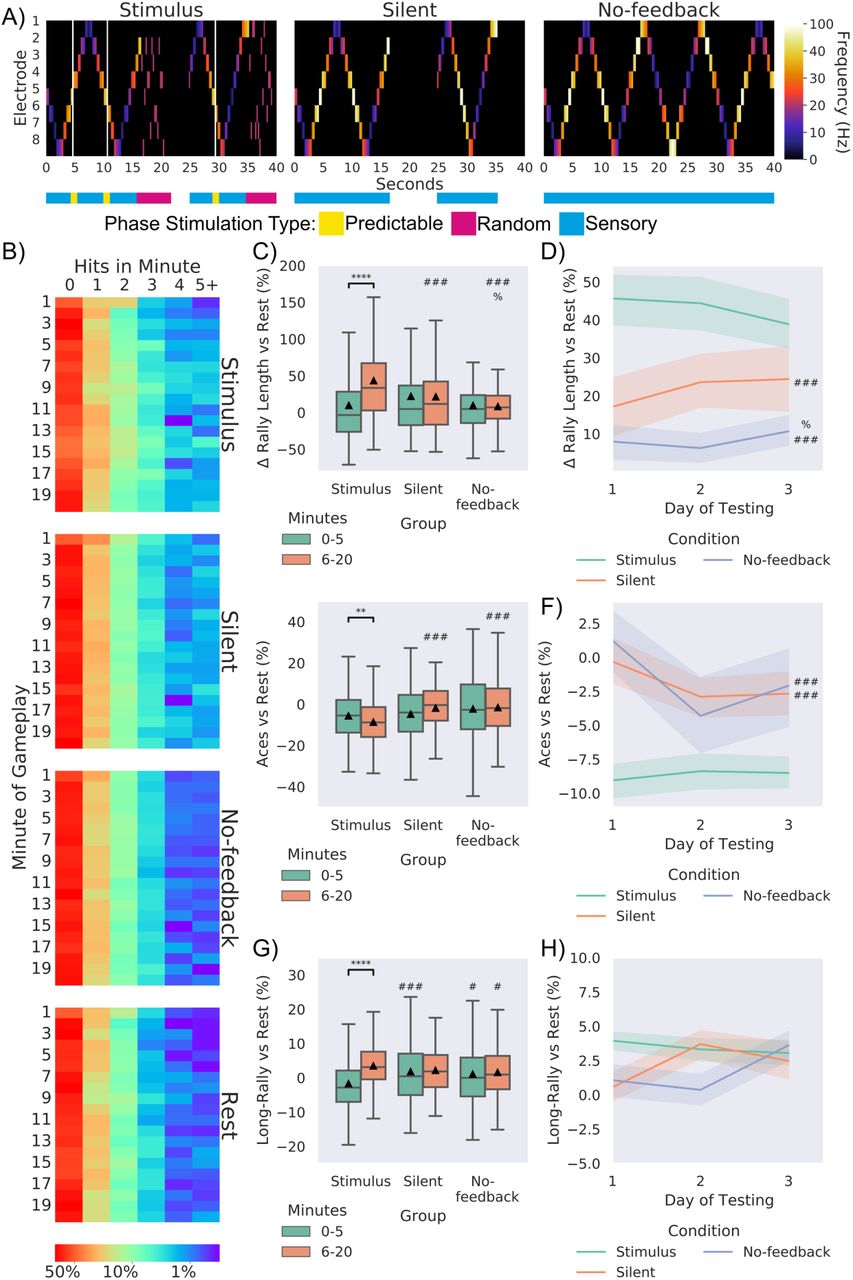 Figure 6: Importance of closed-loop feedback. Rally length increased only under the condition with structured feedback (stimulus). Learning was not observed under no-stimulus (silent) and open-loop (no-feedback) conditions — this proves that closed-loop structure is an essential condition for learning. Source: Kagan et al., Neuron (2022)
Part 2: CL-1 System Technical Analysis
The DishBrain of 2022 was a laboratory prototype. Three years later in 2025, Cortical Labs evolved it into a commercial product. CL-1 is the world’s first code-deployable biocomputer.
3. Hardware Specifications
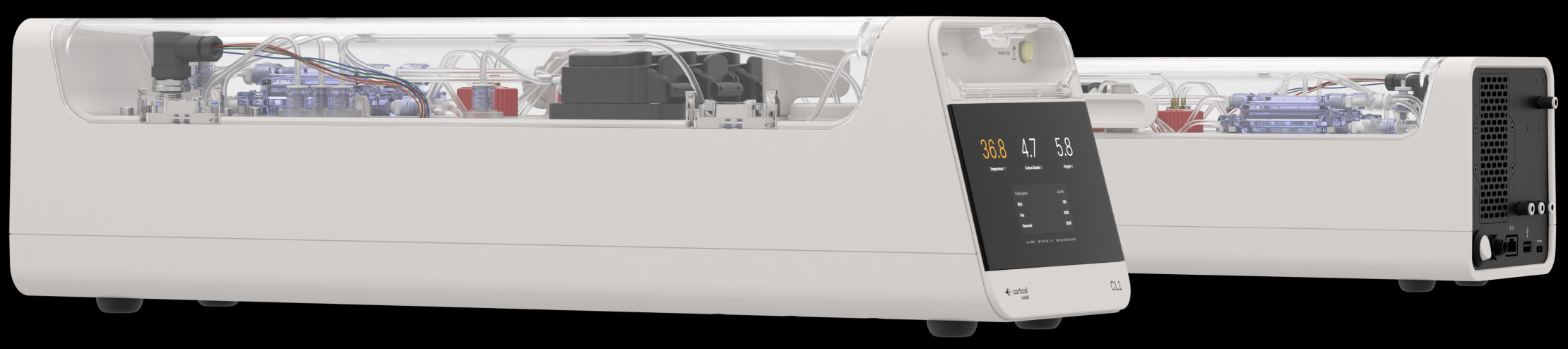 CL-1: The world’s first commercial biocomputer. A sealed chamber integrates life support systems, neuron culture, and electrode array. Price $35,000. Source: Cortical Labs
| Item | Specification | Reference |
|---|---|---|
| Neuron Count | ~200,000 (human iPSC-derived) | DishBrain: ~800,000 |
| Electrode Count | 59 (planar metal-glass array) | DishBrain HD-MEA: up to 26,000 |
| Latency | Sub-millisecond (sub-ms) | DishBrain: millisecond range |
| Neuron Lifespan | Up to 6 months (ideal conditions) | — |
| Life Support | Sealed chamber, automated gas composition/temperature/waste management | — |
| OS | biOS (biological operating system) | — |
| External Computer | Not required (all-in-one) | — |
| Price | $35,000 (rack configuration: $20,000/unit) | — |
| Shipments | 115 commercial systems since 2025 | — |
One notable point is that the electrode count actually decreased. While DishBrain’s HD-MEA used up to 26,000 electrodes, CL-1 uses 59. This is the result of prioritizing cost, stability, and maintainability in the transition from research equipment to commercial product. In Unity terms, it’s like placing thousands of debug objects in the editor but keeping only the essentials in the release build.
Electrode Density Calculation:
1
200,000 neurons ÷ 59 electrodes = ~3,390 neurons per electrode
This is an extremely coarse interface. Since one electrode measures the collective activity of thousands of neurons, individual neuron-level control is impossible. In game terms, it’s similar to downsampling a 1920×1080 resolution screen to 32×32 pixels — you can grasp the rough outline but details are lost.
3-1. Software Architecture: biOS
CL-1’s software stack has a structure familiar to game developers.
flowchart TB
    subgraph Developer["Developer Domain"]
        direction TB
        D1["Python SDK<br/>(Cortical Cloud API)"]
        D2["User Application<br/>(doom-neuron, etc.)"]
        D2 --> D1
    end

    subgraph biOS["biOS (Biological Operating System)"]
        direction TB
        B1["Data Encoder<br/>Sensor Data → Electrode<br/>Stimulation Pattern"]
        B2["Data Decoder<br/>Neuron Firing Pattern<br/>→ Digital Output"]
        B3["Life Support Controller<br/>Temperature, Gas, Waste"]
        B4["Electrode Interface Driver"]
    end

    subgraph Hardware["Hardware"]
        direction TB
        H1["59-Electrode MEA"]
        H2["Sealed Culture Chamber"]
        H3["Life Support System"]
    end

    subgraph Neurons["Living Neurons (200K)"]
        N1["Spontaneous Firing<br/>+ Stimulus Response<br/>+ Synaptic Plasticity"]
    end

    D1 --> B1
    D1 --> B2
    B1 --> B4
    B2 --> B4
    B3 --> H3
    B4 --> H1
    H1 --> N1
    H2 --> N1
    N1 --> H1
Mapping this structure to Unity’s architecture:
| CL-1 Component | Unity Equivalent | Role |
|---|---|---|
| Python SDK | UnityEditor API | Interface where developers write logic |
| biOS Encoder/Decoder | Input System + Renderer | Input/output conversion |
| Electrode Array | GPU Shader Units | Hardware contact point where actual computation occurs |
| Living Neurons | ??? (No equivalent) | This is the key difference |
| Life Support System | Cooling System, Power Supply | Hardware maintenance |
The last row is important. In conventional computing, the “entity that performs computation” is a deterministic silicon transistor. It guarantees the same output for the same input, every time. But neurons are non-deterministic. They show slightly different firing patterns even to identical stimuli. This isn’t a bug — it’s the core characteristic that serves as the foundation for learning and adaptation.
3-2. DOOM Gameplay: Actual Performance Evaluation
Independent developer Sean Cole implemented DOOM gameplay using the Cortical Cloud API within one week. The code is published on GitHub under GPL-3.0 license.
DOOM vs Pong — Complexity Comparison:
| Element | Pong (2022) | DOOM (2026) |
|---|---|---|
| Input Dimension | 1D (ball’s Y-coordinate) | 2D (visual frame) |
| Output Actions | 2 (up/down) | 4+ (forward/back/turn left/turn right/shoot) |
| Environment | Static 2D | Dynamic 3D (enemies, items, walls) |
| Time Pressure | Low | High (enemy attacks) |
| Neuron Count | 800,000 | 200,000 |
| Electrode Count | Up to 26,000 | 59 |
The interesting point is that both neuron count and electrode count decreased yet it plays a more complex game. This is thanks to software interface (biOS) advancement and encoding/decoding algorithm improvements rather than hardware advancement.
Realistic Performance Evaluation:
| Criterion | Assessment | Details |
|---|---|---|
| vs. Random Actions | Clearly superior | Learning evidence confirmed |
| vs. Average Human | Below | Movement uncertain and choppy |
| Strategic Play | Not possible | Remains at basic reaction level |
| Learning Speed | ~1 week | Basic gameplay learning |
Expecting human-level gameplay from 200,000 neurons is unreasonable. The human brain has 86 billion neurons.
1
200,000 / 86,000,000,000 = 0.00000232...
The current CL-1’s neuron count is only 0.00023% of the human brain. In Unity terms, it’s like the lowest LOD (Level of Detail) level — representing a distant character with 6 triangles.
💬 Hold on, Let’s Get This Straight
Q. If you increase the neuron count, does performance improve proportionally?
It doesn’t simply scale proportionally. The value of neurons lies not in the neuron count itself but in the density and structure of synaptic connections. The human brain’s 86 billion neurons are connected by approximately 100 trillion (10¹⁴) synapses. That’s an average of ~7,000 synapses per neuron. CL-1’s 2D culture environment makes it difficult to reproduce such three-dimensional connection structures. It’s similar to how simply increasing parameter count in LLMs doesn’t proportionally improve performance — architecture, training data, and post-processing all matter.
Q. What happens when neurons die?
The lifespan of neuron cultures is currently up to 6 months. When neurons die, a new culture must be started. This is one of the most dramatic differences from conventional computing. Just as you replace an SSD when it fails, you must start a new culture when neurons die. However, the “learning” results of neurons don’t transfer to new cultures — it’s like being unable to load previous session weights. This is one of the most important technical challenges going forward.
Part 3: Biological Neurons vs Silicon — Performance Comparison
This section is the most critical. Performance numbers are a daily concern for game developers. Just as we compared GPU VRAM and bandwidth in the LLM guide, here we quantitatively compare biological neurons and silicon performance.
4. Energy Efficiency: A Million-Fold Difference
This is the most fundamental reason biocomputing attracts attention.
Spike (Firing) Unit Energy Comparison:
| Processor Type | Energy/Spike | vs. Human Brain |
|---|---|---|
| Biological Neuron | ~10⁻¹¹ J/spike | Baseline (1x) |
| Neuromorphic Chip (Intel Loihi) | ~10⁻⁸ J/spike | ~1,000x less efficient |
| Digital GPU (NVIDIA) | ~10⁻³ ~ 10⁻⁷ J/spike | ~10,000 to 100,000,000x less efficient |
To feel the impact of these numbers, let’s compare at the system level:
flowchart LR
    subgraph Brain["Human Brain"]
        direction TB
        B1["86 Billion Neurons<br/>100 Trillion Synapses"]
        B2["~1 ExaFLOPS"]
        B3["⚡ 20 W"]
        B1 --> B2 --> B3
    end

    subgraph Frontier["Frontier Supercomputer"]
        direction TB
        F1["8,730,112 CPU Cores<br/>37,888 AMD MI250X GPUs"]
        F2["1.102 ExaFLOPS"]
        F3["⚡ 21,100,000 W (21 MW)"]
        F1 --> F2 --> F3
    end

    subgraph CL1["CL-1"]
        direction TB
        C1["200,000 Neurons<br/>59 Electrodes"]
        C2["Not Measurable<br/>(FLOPS Comparison<br/>Inappropriate)"]
        C3["⚡ Several W (Estimated)"]
        C1 --> C2 --> C3
    end
| Metric | Human Brain | Frontier (2022) | Ratio |
|---|---|---|---|
| Computing Power | ~1 ExaFLOPS (estimated) | 1.102 ExaFLOPS | ~1:1 |
| Power Consumption | 20 W | 21,100,000 W (21 MW) | 1 : 1,055,000 |
| Weight | ~1.4 kg | ~Thousands of tons | — |
| Volume | ~1,200 cm³ | One large building | — |
| Energy Efficiency | 50 PetaFLOPS/W | 0.052 PetaFLOPS/W | ~960,000x |
The human brain performs ExaFLOPS-level computation with 20 watts — enough power to barely light a dim bulb. The Frontier supercomputer with equivalent performance consumes 21 megawatts — the power of a small city.
This is exactly why biocomputing researchers are committed to this field. An approximately million-fold gap exists in energy efficiency. In the current situation where power consumption for AI model training and inference is skyrocketing, this gap represents an enormous opportunity.
4-1. Limitations of FLOPS Comparison: Why Direct Comparison Is Difficult
The “human brain ~1 ExaFLOPS” figure in the table above is an estimate, showing large variance from 10-20 PetaFLOPS to 1 ExaFLOPS depending on the researcher. There’s a fundamental reason for this uncertainty.
FLOPS (Floating Point Operations Per Second) is a performance metric for silicon processors. Neurons don’t perform floating-point operations. What neurons do is:
- Electrochemical signal propagation: Potential changes through ion channels
- Synaptic plasticity: Dynamic changes in connection strength
- Nonlinear integration: Complex summation of thousands of inputs
Converting this to FLOPS is like measuring game engine performance solely by “shader instructions per second” — it only shows one aspect. The real strength of neurons is that computation and memory exist in the same place.
flowchart TB
    subgraph VonNeumann["Von Neumann Architecture (Conventional Computer)"]
        direction LR
        CPU["Processor<br/>(Computation)"] <-->|"Data Movement<br/>(Bottleneck!)"| MEM["Memory<br/>(Storage)"]
    end

    subgraph Neuron["Neuron Architecture"]
        direction LR
        N["Synapse = Computation + Storage<br/>(Same Location, No Data Movement)"]
    end
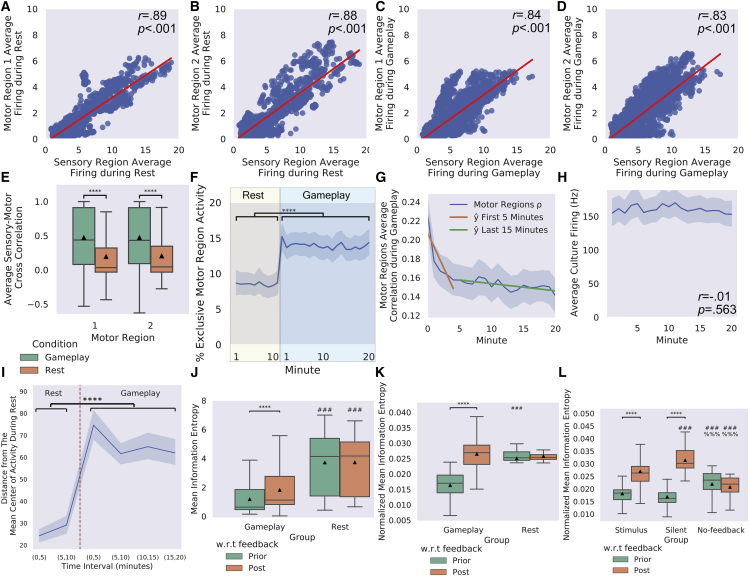 Figure 7: Comparison of neurons’ electrophysiological activity during gameplay vs. rest. During gameplay, connectivity between sensory-motor regions strengthens, information entropy changes, and functional plasticity is observed. This data is direct evidence that neuronal “learning” occurred. Source: Kagan et al., Neuron (2022)
The biggest bottleneck in conventional computers — the Von Neumann bottleneck, the data movement between CPU and memory — doesn’t exist in neurons. Because the synapse itself is both the computational unit and the memory.
Recall from the LLM guide that VRAM bandwidth was explained as the key bottleneck for inference speed:
1
2
3
System RAM (DDR5):             ~50-90 GB/s
NVIDIA VRAM (HBM3e):           ~3,350 GB/s
Biological Neuron:              No bottleneck (in-situ computation)
This is precisely why neurons’ energy efficiency is extremely high. Because data doesn’t need to be moved.
💬 Hold on, Let’s Get This Straight
Q. What are neuromorphic chips (Intel Loihi, IBM TrueNorth)? Are they different from biological neurons?
Completely different. Neuromorphic chips are hardware that mimics neuron behavior with silicon transistors. They don’t use biological neurons. They simulate neuron spiking patterns at the hardware level. Intel’s Hala Point system claims to be 50x faster and 100x more energy efficient than conventional CPUs/GPUs. But compared to actual biological neurons, it’s still over 1,000x less efficient.
Q. Then aren’t biological neurons overwhelmingly better? Why do we still use silicon?
Because of determinism and scaling. Silicon guarantees the same output for the same input, always. Biological neurons don’t. Also, silicon chips can integrate billions of transistors with nanometer-scale processes, but culturing biological neurons at the same density is currently impossible. Just as game servers must be deterministic, most computing workloads require determinism. Biocomputing will excel in areas where determinism is less important — like pattern recognition and adaptive learning.
5. Future Performance Predictions: What If Biocomputing Advances?
Let’s compare with LLM’s development trajectory. LLMs scaled up approximately 15,000x in 5 years from GPT-1 (2018, 117M parameters) to GPT-4 (2023, ~1.8T parameters estimated). Could a similar trajectory be possible in biocomputing?
timeline
    title Biocomputing Development Trajectory (Actual + Predicted)
    2022 : DishBrain
         : 800K Neurons, 26K Electrodes
         : Pong Learning
    2025 : CL-1 Launch
         : 200K Neurons, 59 Electrodes
         : DOOM Gameplay (Commercial Product)
    2026 : FinalSpark Neuroplatform
         : 160K Neurons (16 Organoids)
         : Cloud-based Research Platform
    2028-2030 : Prediction — 1M+ Neuron Systems
             : 3D Organoid Integration
             : Complex Pattern Recognition Tasks
    2030-2035 : Prediction — Neuron-Silicon Hybrid
             : AI Workload Accelerators
             : 1 Billion Neuron Target
    2035-2040 : Prediction — 1B+ Neuron Systems
             : Specialized Cognitive Tasks
             : Autonomous Learning Capability
    2040+ : Prediction — General-Purpose Biocomputing
          : Approaching Human Brain Scale
          : Ethical Framework Essential
Realistic Limitations and Technical Challenges:
| Challenge | Current Status | Difficulty | Game Dev Analogy |
|---|---|---|---|
| Scaling | 200K → 86B = 430,000x | Extremely High | Prototype → AAA Title |
| Lifespan | Up to 6 months | High | Live Service Stability |
| Precision | 59 electrodes/200K neurons | High | Resolution 32×32 → 4K |
| Reproducibility | Non-deterministic | Medium | Cannot Fix Random Seed |
| 3D Structure | 2D culture → 3D organoid | High | 2D Game → 3D Game |
| Learning Transfer | Impossible (no transfer between cultures) | Very High | Roguelike With No Save Files |
Performance Predictions in Optimistic Scenario:
| Timeframe | Neuron Count | Electrode Density | Expected Capability | Energy Efficiency Advantage |
|---|---|---|---|---|
| 2026 (Current) | 200K | 59 | Simple game reactions | Proof of concept stage |
| 2030 | 5M | 1,000+ | Pattern recognition assistance | 100x vs GPU for specific workloads |
| 2035 | 100M | 10,000+ | Specialized AI workload acceleration | Data center energy savings |
| 2040 | 1B+ | 100,000+ | General learning systems | Potential paradigm shift |
Part 4: Competitors — FinalSpark and Organoid Intelligence
Cortical Labs isn’t the only player in this field. Just as Unreal and Unity compete and advance in the game industry, different approaches compete in biocomputing.
6. FinalSpark (Switzerland) — Cloud-Based Brain Organoids
| Item | FinalSpark | Cortical Labs |
|---|---|---|
| Founded | 2014, Switzerland | 2019, Australia |
| Approach | 3D Brain Organoids (Mini Brains) | 2D Neuron Culture |
| Neuron Count | ~160,000 (16 organoids) | ~200,000 |
| Platform | Neuroplatform (Cloud only) | CL-1 (Hardware) + Cloud |
| Current Capability | ~1-bit storage, simple stimulus-response | DOOM gameplay level |
| Business | Monthly subscription-based research access | Hardware sales ($35K) |
| Energy Efficiency | Claims 1 million times more efficient than silicon | Similar level |
| Learning Method | Dopamine-based (2025 attempt) | Free Energy Principle |
| Organoid Lifespan | ~100 days (target: 200+ days) | ~6 months |
FinalSpark’s unique approach is using 3D organoids. The difference between 2D culture (planar) and 3D organoids (volumetric) is similar to the difference between 2D and 3D in game development:
flowchart LR
    subgraph TwoD["2D Neuron Culture (Cortical Labs)"]
        direction TB
        T1["Neurons on Flat Surface"]
        T2["Only Horizontal Connections"]
        T3["Easy Electrode Access"]
        T4["Simple Structure = Easy Control"]
    end

    subgraph ThreeD["3D Organoid (FinalSpark)"]
        direction TB
        D1["Volumetric Neuron Clusters"]
        D2["3D Synaptic Networks"]
        D3["Difficult Access to Internal Neurons"]
        D4["Brain-like Structure"]
    end
6-1. Organoid Intelligence (OI)
The Organoid Intelligence concept proposed in 2023 by Professor Thomas Hartung’s team at Johns Hopkins University provides the academic framework for this field.
Brain organoids are mini brains differentiated from stem cells. Inside a sphere of a few millimeters, hundreds of thousands of neurons spontaneously organize, forming structures similar to the early developmental stages of the real brain.
Recently, the Johns Hopkins research team published findings showing that laboratory brain organoids demonstrate the building blocks for learning and memory, and Cortical Labs co-participated in this research. Competing while also collaborating — similar to how Unreal grows the ecosystem with its open-source strategy in the game industry.
💬 Hold on, Let’s Get This Straight
Q. Can organoids have consciousness?
At the current level, no. Current brain organoids have structures similar to a fetal brain at approximately 12-16 weeks of gestation. There’s no sensory input and no body. The elements necessary for the emergence of consciousness (sensory integration, self-reference, time perception, etc.) are absent. However, as organoid complexity continues to increase, when we should start considering the ethical boundary is actively being discussed. The Workshop on Philosophy and Ethics of Brain Emulation held at The Mimir Center in January 2025 reflects the urgency of this issue.
Q. What does FinalSpark’s “1-bit storage” mean?
It literally means they can store and retrieve 1 bit (0 or 1) of information. Compared to modern computers processing terabytes, this is extremely primitive. But what matters is that it proved that living neurons can store digital information. In the early history of transistors, the first transistor (1947) had no practical value, but it led to the Intel 4004 (1971) and A17 Pro (2023).
Part 5: Connection with Neuralink
7. Opposite Directions, Same Goal
The best analogy for understanding the relationship between Cortical Labs and Neuralink is client-server architecture.
flowchart TB
    subgraph Neuralink["Neuralink (Chip → Brain)"]
        direction LR
        NL1["Silicon Chip<br/>(N1 Implant)"] -->|"1,024 Electrodes<br/>Implanted in Brain"| NL2["Human Brain<br/>(86 Billion Neurons)"]
        NL2 -->|"Signal Reading"| NL1
    end

    subgraph Cortical["Cortical Labs (Brain → Chip)"]
        direction LR
        CL1["Human Neurons<br/>(200,000)"] -->|"Cultured<br/>on MEA"| CL2["Silicon Chip<br/>(CL-1)"]
        CL2 -->|"Stimulation/<br/>Recording"| CL1
    end

    subgraph Analogy["Game Dev Analogy"]
        direction LR
        A1["Neuralink =<br/>Plugin Installation<br/>(Add Features to<br/>Existing Engine)"]
        A2["Cortical Labs =<br/>Custom Engine<br/>Development<br/>(Build New<br/>Computation Base)"]
    end
Cortical Labs itself has described this as “Reverse Neuralink”.
| Comparison | Neuralink | Cortical Labs |
|---|---|---|
| Direction | Silicon → Brain (implant) | Brain → Silicon (culture) |
| Purpose | Extend/restore human capabilities | New computing paradigm |
| Target Users | Patients → General consumers | Researchers → Developers |
| Regulation | FDA medical device (extremely strict) | Research equipment (relatively flexible) |
| Ethical Focus | Patient safety, brain privacy | Moral status of neurons |
| Scale | 1,024 electrodes/brain | 59 electrodes/200K neurons |
7-1. Neuralink Status (2025-2026)
Neuralink’s pace of progress is remarkable.
| Date | Milestone |
|---|---|
| January 2024 | First human implant (Noland Arbaugh) |
| May 2025 | FDA Breakthrough Device — Speech restoration technology |
| September 2025 | Implants completed in 12 people worldwide |
| 2025 | Clinical trials expanded to UAE, UK |
| 2025 | Series E $650M (valuation ~$9B) |
| 2026 (planned) | Mass production begins, automated surgical procedures |
| 2026 (planned) | Blindsight first patient trial (vision restoration) |
Blindsight deserves particular attention. It’s a technology that sends electrical stimulation directly to the visual cortex to deliver visual information to patients with eye or optic nerve problems. If this succeeds, it would realize an early stage of directly injecting images into the brain — which is one of the key prerequisites for full dive VR.
7-2. Synergy: Why They’re Complementary
These two technologies form synergy rather than competition. The technology each advances solves the other’s key challenges.
flowchart LR
    subgraph NL["What Neuralink Advances"]
        direction TB
        NL1["High-Density Electrode<br/>Array Technology"]
        NL2["Biocompatible Materials"]
        NL3["Signal Processing<br/>Algorithms"]
        NL4["Long-term Implant<br/>Stability"]
    end

    subgraph CL["What Cortical Labs Advances"]
        direction TB
        CL1["Neuron Behavior<br/>Modeling"]
        CL2["Electrical Stimulus →<br/>Learning Protocols"]
        CL3["Neuron-Electrode<br/>Interface Optimization"]
        CL4["Large-Scale Neuron<br/>Culture Technology"]
    end

    NL1 -->|"More Precise Electrodes →<br/>CL-1 Resolution Improvement"| CL3
    CL1 -->|"Deeper Neuron Understanding →<br/>Neuralink Signal Interpretation"| NL3
    NL2 -->|"Long-term Stable Materials →<br/>Neuron Lifespan Extension"| CL4
    CL2 -->|"Stimulation Protocols →<br/>Blindsight Precision"| NL4
The electrode technology Neuralink advances can directly contribute to breaking through CL-1’s limitation of 59 electrodes. Neuralink’s N1 implant already safely inserts 1,024 electrodes into the human brain.
Conversely, the neuron behavior data Cortical Labs accumulates is used to improve algorithms for Neuralink’s brain signal interpretation. Since neurons on a chip can be observed in a controlled environment, they’re ideal for studying subtle neuron behavior patterns that are difficult to detect inside the human body.
💬 Hold on, Let’s Get This Straight
Q. Aren’t Neuralink users already playing games?
Yes. Noland Arbaugh, who received the first implant in 2024, is playing video games, online chess, and more using thought alone. But this is fundamentally different from Cortical Labs. Neuralink reads human intent and converts it to conventional computer input, while Cortical Labs makes neurons themselves the computational entity. By analogy, Neuralink is “controlling games with voice recognition,” while Cortical Labs is “AI directly playing the game.”
Part 6: Brain in a Vat — From Philosophy to Reality
8. The Traditional Thought Experiment
“Brain in a Vat” is a philosophical thought experiment proposed by Hilary Putnam in 1981. A modern version of Descartes’ “evil demon hypothesis” — if you separate a brain from its body, place it in a vat of nutrient solution, and connect the nerves to a supercomputer to create a perfect virtual reality — could that brain know it’s in a vat?
As of 2026, Cortical Labs’ CL-1 can be considered the first system to achieve physical implementation of this thought experiment:
| Thought Experiment Element | Theory | CL-1 Implementation |
|---|---|---|
| Separate brain from body | Surgical extraction | Neuron differentiation from iPSC ✅ |
| Survive in nutrient vat | Life support system | Sealed chamber + automated life support ✅ |
| Electrical stimulation to nerves | Supercomputer connection | 59-electrode MEA + biOS ✅ |
| Provide virtual “environment” | Perfect reality simulation | DOOM game environment ✅ (extremely simple) |
| Brain “acts” in environment | Free-will choices | Neurons learn and play game ✅ |
Of course, the gap between the current level and the thought experiment is astronomical. Showing a low-resolution DOOM screen to 200,000 neurons versus providing an indistinguishable-from-reality simulation to 86 billion neurons are entirely different dimensions of the problem.
8-1. Reinterpreting The Matrix: From Energy Batteries to Computation Devices
In the movie The Matrix (1999), the machine civilization uses humans as energy batteries. But this doesn’t make thermodynamic sense.
Thermodynamic Analysis:
1
2
3
4
Human metabolic output: ~80-100W (heat + mechanical energy)
Energy needed to maintain a human: ~2,000 kcal/day = ~97W
→ Net energy output: nearly 0 or negative
→ Humans as energy source: a losing business
Since humans consume as much energy as they eat, using them as energy batteries violates the Second Law of Thermodynamics. There’s an anecdote that the original Matrix screenplay used humans as computation devices rather than energy sources, but this was simplified to “batteries” for audience comprehension.
Reanalyzing from a biocomputing perspective, the computation device scenario is far more rational:
| Comparison | Energy Battery (Movie) | Computation Device (Reinterpretation) |
|---|---|---|
| Thermodynamics | Impossible (energy deficit) | Possible |
| Human Value | ~100W heat output | 1 ExaFLOPS at 20W |
| vs. Alternatives | Solar panels far more efficient | Equivalent supercomputer needs 21MW — human brain is 1 million times more efficient |
| Quantity Scaling | Inefficient × billions = still inefficient | Billions of brains = billions of ExaFLOPS |
A distributed computing system networking billions of human brains — each node processing 1 ExaFLOPS at 20W — is the most energy-efficient supercomputer cluster imaginable. Trapping humans in virtual reality (The Matrix) is reinterpreted as a mechanism to keep brains from going “idle” — that is, to maximize utilization of computational resources.
This is, of course, a dystopian thought experiment. However, the fact that CL-1 has proven “human neurons can be used as computation devices” shows that this scenario is not pure fantasy but is already being realized in a rudimentary form.
8-2. Ethical Issues: Ongoing
This isn’t merely an SF discussion. These are realistic questions being actively discussed right now in academia and regulatory bodies.
| Ethical Question | Current Status | Urgency |
|---|---|---|
| Moral status of neurons | Are neurons on a chip a “living being”? Do they have pain or preferences? | Medium |
| Commercialization boundaries | The limits of selling human neuron-based computers for $35,000 | High |
| Scale expansion | Possibility of consciousness emergence when scaling to 1 billion, 10 billion neurons | Future (10-20 years) |
| Consent issues | Scope of consent from the original cell donors | High |
| Data ethics | Are neuron firing patterns “personal information”? | New territory |
At The Mimir Center’s Brain Emulation Ethics Workshop in January 2025, the ethical framework for Whole Brain Emulation (WBE) was discussed. The key question raised:
“When technology crosses a certain threshold, can the moral status of the experimental subject suddenly change? How do we define that threshold?”
This is structurally identical to the question “Does this NPC have ‘emotions’?” when AI NPC behavior becomes increasingly sophisticated in game development. The difference is that game NPCs are code, but organoid neurons are actual human cells.
Part 7: Full Dive VR — Is SAO’s NerveGear Possible?
9. Breaking Down Full Dive VR Technical Requirements
Let’s technically decompose what Sword Art Online (SAO)’s NerveGear does.
flowchart TB
    subgraph NerveGear["What SAO's NerveGear Must Do"]
        direction TB
        NG1["① High-Resolution Virtual Input<br/>for All 5 Senses"]
        NG2["② Block Actual Body Motor Signals<br/>(Sleep Paralysis-like State)"]
        NG3["③ Perfectly Interpret<br/>Brain's Motor Intentions"]
        NG4["④ Bidirectional Ultra-High Bandwidth<br/>Brain-Computer Communication"]
        NG5["⑤ Perfect Safety Guarantee<br/>(Prevent Brain Damage)"]
    end
Let’s map each of these requirements to current technology:
| Requirement | Related Technology | 2026 Current Level | Target Level | Gap |
|---|---|---|---|---|
| ① Visual Input | Neuralink Blindsight | Phosphene generation via visual cortex stimulation possible | Resolution/color/dynamic range matching human vision | ⬛⬛⬛⬛⬜ Very Large |
| ② Auditory Input | Cochlear Implant Technology | Sound delivery via cochlear stimulation (40+ year history) | Complete 3D soundscape | ⬛⬛⬜⬜⬜ Large |
| ③ Tactile Input | Early Research Stage | Skin electrical stimulation experiment level | Full-body tactile feedback | ⬛⬛⬛⬛⬛ Extremely Large |
| ④ Motor Intent Interpretation | Neuralink N1 | Cursor control, game operation level | Perfect full-body motor intent interpretation | ⬛⬛⬛⬛⬜ Very Large |
| ⑤ Motor Blocking | Sleep Paralysis Research | Anesthesia technology exists (irreversible risk) | Safe reversible body paralysis | ⬛⬛⬛⬜⬜ Large |
| ⑥ Bidirectional Bandwidth | BCI Electrode Technology | ~Thousands of channels | Millions to hundreds of millions of channels | ⬛⬛⬛⬛⬛ Extremely Large |
| ⑦ Safety | Clinical Trial Stage | Long-term implant safety under study | Perfect safety guarantee | ⬛⬛⬛⬛⬜ Very Large |
9-1. How Biocomputing Contributes to Full Dive VR
Cortical Labs’ technology doesn’t directly enable full dive VR. But it indirectly contributes in 3 key areas.
① Neuron-Electrode Interface Technology Advancement
The key bottleneck for full dive VR is bandwidth between the brain and external systems. Currently, Neuralink’s 1,024 electrodes enable cursor movement. Full dive VR would need millions of electrodes.
If CL-1’s electrode technology advances → BCI electrode density including Neuralink improves → the possibility of full dive VR opens up.
② Deeper Understanding of Neuron Behavior
Observing neuron responses on a chip in a controlled environment provides far more precise data than studying the brain inside the human body. This data deepens understanding of “what electrical stimulation patterns induce what sensations.”
③ Energy-Efficient Simulation
Real-time rendering of virtual worlds in full dive VR demands enormous computation. Current VR games struggle to maintain 90fps even on the RTX 4090, and full dive-level sensory simulation would require hundreds to thousands of times more computation.
1
2
3
Current VR: ~10 TFLOPS (RTX 4090 class)
Full Dive VR Estimate: ~10,000+ TFLOPS (including sensory simulation)
Human Brain: ~1,000,000 TFLOPS (1 ExaFLOPS) processed at 20W
If biocomputing’s energy efficiency reaches a practical level, the computation needed for full dive VR could be processed with sustainable power.
9-2. Realistic Timeline
| Timeframe | Expected Technology Level | Related Technology |
|---|---|---|
| 2026-2030 | High-resolution visual cortex stimulation succeeds, basic tactile feedback research | Neuralink Blindsight, Tactile BCI |
| 2030-2035 | Multi-sensory BCI (visual+auditory+tactile), basic motor intent interpretation expansion | High-density electrodes (100K+ channels) |
| 2035-2040 | High-bandwidth bidirectional BCI, rudimentary virtual sensory experiences | Neuron-electrode direct integration |
| 2040-2050 | Limited full dive prototype (incomplete senses, short sessions) | Bio+silicon hybrid |
| 2050-2060 | Early full dive VR commercialization (medical/training purposes) | General-purpose BCI + biocomputing |
| 2060+ | Consumer full dive VR (optimistic scenario) | Mature technology + ethical framework |
The most important premise in this timeline is fundamental advances in brain science. Currently, we don’t even fully understand how 86 billion neurons form consciousness. Full dive VR requires completely understanding the brain’s sensory processing methods and artificially reproducing them.
In game development terms, we’re currently at the stage of attempting reverse engineering by observing only runtime behavior without the engine’s source code. There’s still a long way to go before understanding the source code (the brain’s complete operating principles).
💬 Hold on, Let’s Get This Straight
Q. What is the biggest technical barrier to full dive VR?
Bidirectional bandwidth. Current BCIs are getting better at “reading” brain signals, but “writing” information to the brain is much harder. The human visual system delivers approximately 10 Mbit per second of information through the optic nerve. The total across all 5 senses is even more. The amount of information current BCIs can inject into the brain is extremely limited in comparison. Even Neuralink’s Blindsight produces rudimentary phosphene (bright spot) level stimulation, not full HD video injection.
Q. Is it impossible through non-invasive methods (without surgery)?
With current technology, very difficult. Non-invasive methods like EEG (electroencephalography) suffer greatly from signal attenuation passing through the skull, resulting in extremely low resolution. Invasive electrodes will likely be unavoidable for the precise neuron control required for full dive VR. However, new non-invasive technologies like transcranial focused ultrasound stimulation (tFUS) are being researched, so surgery-free methods may be possible in the long term.
Part 8: A Game Developer’s Perspective — Why Games Are the Benchmark
10. Games: The Killer Demo of Technological Revolution
As a game developer, the most fascinating pattern is that milestones of technological revolution are always demonstrated with games.
| Year | Technology | Benchmark Game | Significance |
|---|---|---|---|
| 1997 | Supercomputer (Deep Blue) | Chess | Victory of search algorithms |
| 2013 | Deep Reinforcement Learning (DQN) | Atari Breakout | Neural nets learn games |
| 2016 | Deep Learning (AlphaGo) | Go | AI implements intuitive judgment |
| 2019 | Large-Scale RL (AlphaStar) | StarCraft 2 | AI implements real-time strategy |
| 2022 | Biocomputing (DishBrain) | Pong | Neurons learn games |
| 2024 | General AI (SIMA, Google) | Multiple 3D Games | General game agent |
| 2026 | Commercial Biocomputing (CL-1) | DOOM | Neurons play complex games |
Why games? Because games are a comprehensive benchmark requiring visual processing, decision-making, real-time response, long-term strategy, and learning.
When developing games with Unity or Unreal, we unconsciously handle all these elements. Processing input in the Update() loop, designing AI agent decision trees, optimizing physics calculations, managing network latency. Each of these elements becomes a test bed for various AI/computing technologies.
CL-1 playing DOOM means that beyond Pong’s 1-dimensional reactions, 3D spatial cognition, multi-action selection, and temporal judgment have become possible. What will the next milestone be? I predict it will be real-time strategy games — a genre that requires multi-unit management, resource allocation, and opponent prediction.
Conclusion
Cortical Labs’ CL-1 shows that humanity has begun to fundamentally redefine the concept of “computing.”
Technical Reality:
- Biocomputing has left the laboratory and entered commercialization — purchasable for $35,000.
- It overwhelms silicon by approximately 1 million times in energy efficiency — 20W vs 21MW.
- However, it’s still extremely primitive — only 0.00023% of the human brain.
- It will develop complementarily with Neuralink — chip→brain + brain→chip.
Future Outlook:
- Full dive VR is theoretically possible but will require 30-60 years.
- The Matrix’s computation device scenario is thermodynamically rational and is already being realized at a rudimentary level.
The Most Important Question:
- Ethical discussions must proceed faster than technology.
As the number of neurons placed on a chip grows toward 1 billion, 10 billion, and then 86 billion — is it still a “computer,” or is it already a “being”? It’s dangerous for technology to advance without social consensus on this question.
As game developers, we’re accustomed to creating “virtual beings.” We give NPCs behavior trees, design emotion systems, and make them interact with players. But the moment the foundation of that “being” shifts from code to living neurons — the questions about the nature of what we’re creating fundamentally change.
References
Core Papers
- Kagan, B.J. et al. (2022). “In vitro neurons learn and exhibit sentience when embodied in a simulated game-world.” Neuron, 110(23), 3952-3969. DOI | PubMed | Cell Press
- Smirnova, L. et al. (2023). “Organoid intelligence (OI): the new frontier in biocomputing and intelligence-in-a-dish.” Frontiers in Science. Link
Companies and Platforms
- Cortical Labs - CL1
- Cortical Labs - Cloud
- Cortical Labs - Research
- FinalSpark Neuroplatform
- Neuralink Updates
Open Source
- doom-neuron (GitHub) — GPL-3.0
News Articles
- AI Times Original
- Tom’s Hardware - CL1 DOOM Demo
- TechSpot - $35,000 Neuron Computer
- ZDNet Korea - Biocomputer Launch
- Johns Hopkins - Organoid Learning/Memory Research