Linear Algebra - 1.7 Introduction to Linear Transformation

- Linear Algebra - 1.1 Systems of Linear Equations
- Linear Algebra - 1.2 Row Reduction and Echelon Forms
- Linear Algebra - 1.3 Vector Equations
- Linear Algebra - 1.4 The Matrix Equation Ax=b
- Linear Algebra - 1.5 Solution Sets of Linear Systems
- Linear Algebra - 1.6 Linear Independence and Linear Dependence
- Linear Algebra - 1.7 Introduction to Linear Transformation
- Linear Algebra - 1.8 The Matrix of a Linear Transformation
- Linear Algebra - 2.1 Matrix Operations
- Linear Algebra - 2.2 The Inverse of Matrix
- Linear Algebra - 2.3 Characterizations of Invertible Matrices of
- Linear Algebra - 2.4 Partitioned Matrices
- Linear Algebra - 2.5 Matrix Factorizations, LU Decomposition
- Linear Algebra - 2.6 Subspaces of $\mathbb{R}^n$
- Linear Algebra - 2.7 Dimension and Rank
- Linear Algebra - 3.1 Introduction to Determinants
- Linear Algebra - 3.2 Properties of Determinants
- Linear Algebra - 3.3 Cramer's Rule, Volume, And Linear Transformations
- Linear Algebra - 4.1 Eigenvectors and Eigenvalues
- Linear Algebra - 4.2 The Characteristic Equation
- Linear Algebra - 4.3 Diagonalization
- Linear Algebra - 4.4 Eigenvectors And Linear Transformations
- Linear Algebra - 4.5 Complex Eigenvalues
- Linear Algebra - 5.1 Inner Product And Orthogonality
- Linear Algebra - 5.2 Orthogonal Sets
- Linear Algebra - 5.3 Orthogonal Projections
- Linear Algebra - 5.4 The Gram-Schmidt Process (그람 슈미츠 과정)
- Linear Algebra - 5.5 Least-Square Problems
- Linear Algebra - 6.1 Diagonalization of Symmetric Matrices
- Linear Algebra - 6.2 Quadratic Forms
- Linear Algebra - 6.3 Constrained Optimization
- Linear Algebra - 6.4 SVD, The Singular Value Decomposition
- Linear Algebra - 6.5 Reduced SVD, Pseudoinverse, Matrix Classification, Inverse Algorithm

용어 정리
- Matrix Multiplication (행렬 곱셈)
- Transformation (변환)
- matrix transformation (행렬 변환)
- linear transformation (선형 변환)
Matrix Multiplication - 행렬 곱셈
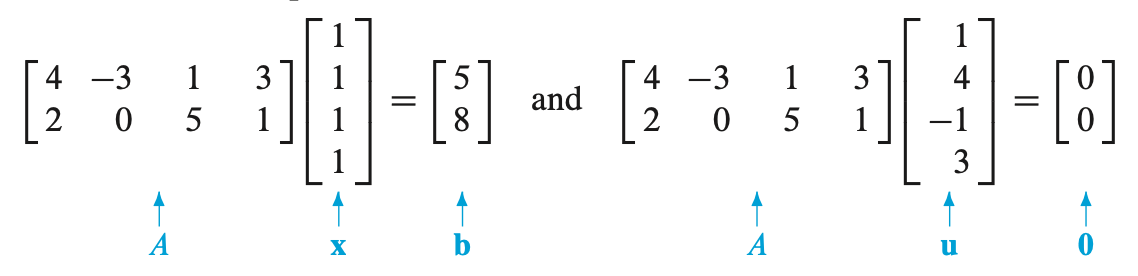
- x 가 A vector 에 의해 b 가 되었다.
- u 가 A vector 에 의해 0 이 되었다.
벡터 x 는 $ \mathbb{R}^{4} $ 공간에 있다. 여기에 A matrix 를 곱한 b를 보면 $ \mathbb{R}^{2} $ 공간으로 이동한것을 확인할 수 있다. 이런 이동을 Transformation 이라 한다. 또는 function, mapping 이라고 말한다.
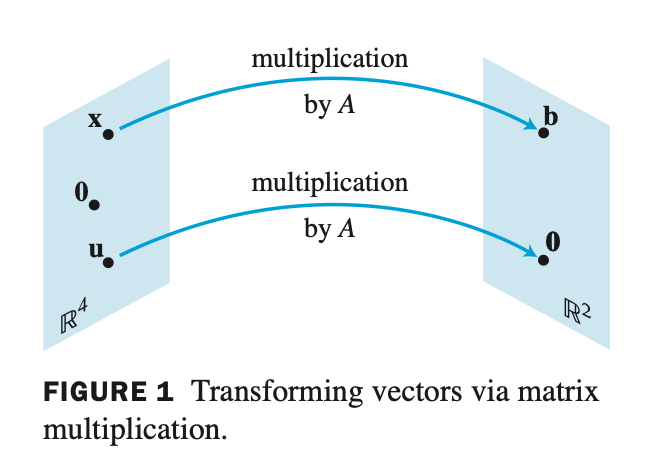
- A vector 가 $ \mathbb{R}^{4} $ space 에 있는 x vector를 $ \mathbb{R}^{2} $ space로 Transformation 시켰다.
- Transformation 은 이처럼 Matrix Multiplication에 의해 발생한다.
Transformation
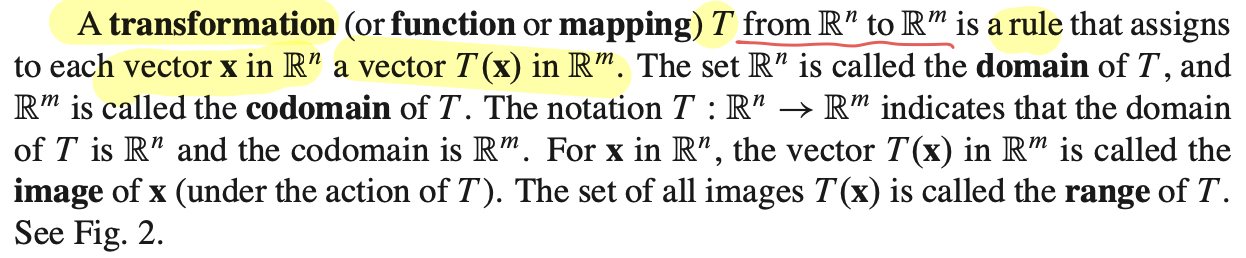
- $\mathbb{R}^{n}$ 에서 $ \mathbb{R}^{m}$ 로의 transformation (or function or mapping) $T$는 규칙이 있다.
- $ \mathbb{R}^{n}$ 에 있는 vector x를 $ \mathbb{R}^{m} $ 에 있는 $T(\mathrm{x})$ 로 할당하는 것이다. 이 규칙을 Transformation (변환) 이라한다.
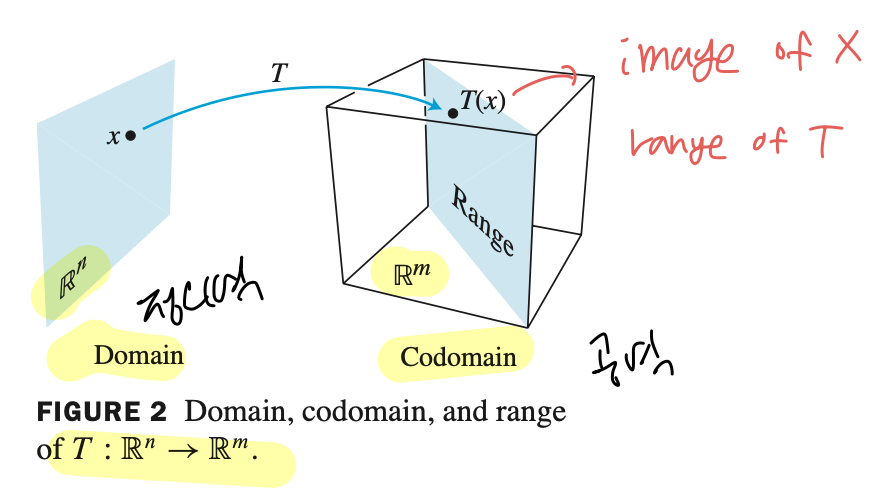
- $\mathbb{R}^{n}$ 공간을 Domain (정의역)
- $\mathbb{R}^{m}$ 공간을 Codomain (공역) 이라 한다.
- Transformation 은 위 기호처럼 나타낼 수 있다.
- 여기서 $T(\mathrm{x})$를 x의 image 라고 한다. image의 모든 set을 $T$의 range 라고 한다.
Matrix Transformation
- Matrix Transformation 은 $\mathbb{R}^{n}$ space 의 Domain 에 있는 x 를 $\mathbb{R}^{m}$ space의 Codomain으로 Transformation 하는 것이다.
- $\mathbb{R}^{n}$ space에 있는 x 에 대해서 $T(\mathrm{x})$ 는 $A\mathrm{x}$ 를 계산하는 것이다. 여기서 $A$는 $m \times n$ 행렬이다.
- 기호는 아래와 같이 표현 가능하다. (x 의 image 는 Ax가 된다.)
Transformation 예시
1번 예제
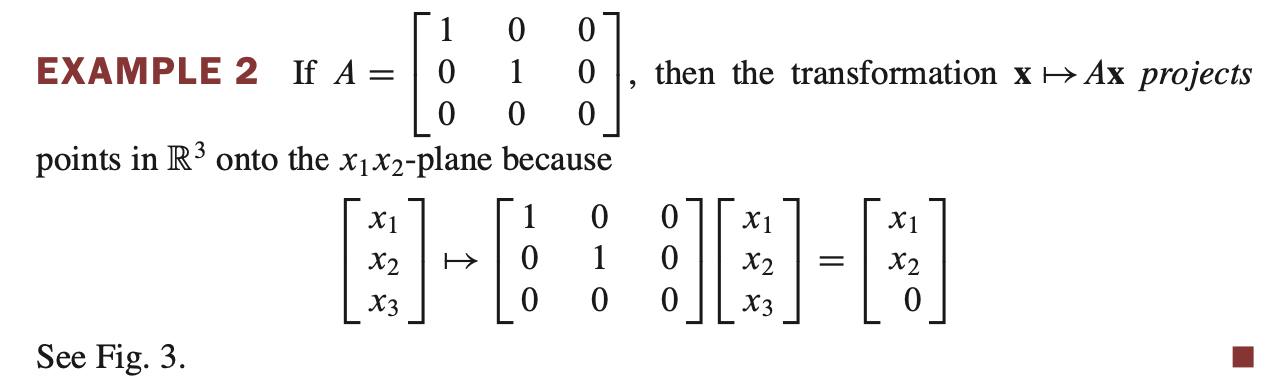
matrix A로 x를 이동시키면 $x_3$ 는 모두 0이 되어서 공간에 있던 모든 점들이 한 면으로 모인다. (이를 projection 이라고 한다.)
이를 기하학적으로 표현하면
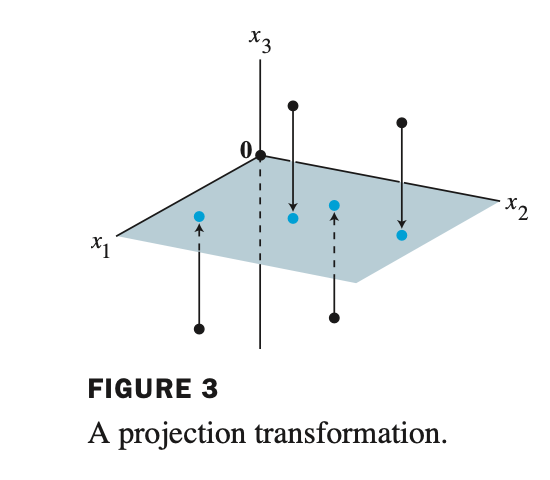
3차원에 있는 임의의 vector에서 $x_3$ 에 해당하는 value가 zero가 되었다. 따라서 Span {$ x_1, x_2 $} 평면으로 표현된다.
- 2번 예제
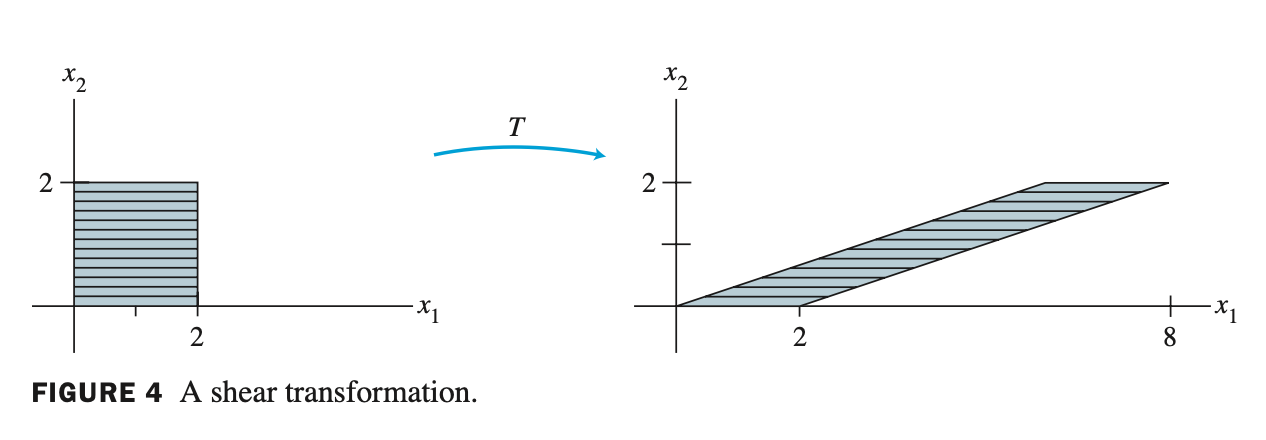
- 이런 transformation을 shear transformation 이라고도 한다.
Linear Transformation - 선형 변환
Transformation 이 Linear Transformation 이라고 불릴 조건에 대해서 알아보자.

- 이 두 가지 조건을 만족하는 Transformation 은 Linear Transformation이다.
이는 Theorem 5 와 동일하다!! matrix equation 은 linear system 이고 이것은 위 두 조건을 성립한다고 배웠다. 마찬가지로 위 두 조건을 만족하면 transformation 도 linear로 정의가 가능하다.
$m \times n$ matrix 가 Theorem5 성질을 지니고 있으므로 모든 matrix transformation 은 linear transformation이다. linear transformation 이 아닌 transformation이 있지만, matrix transformation은 linear transformation이다.
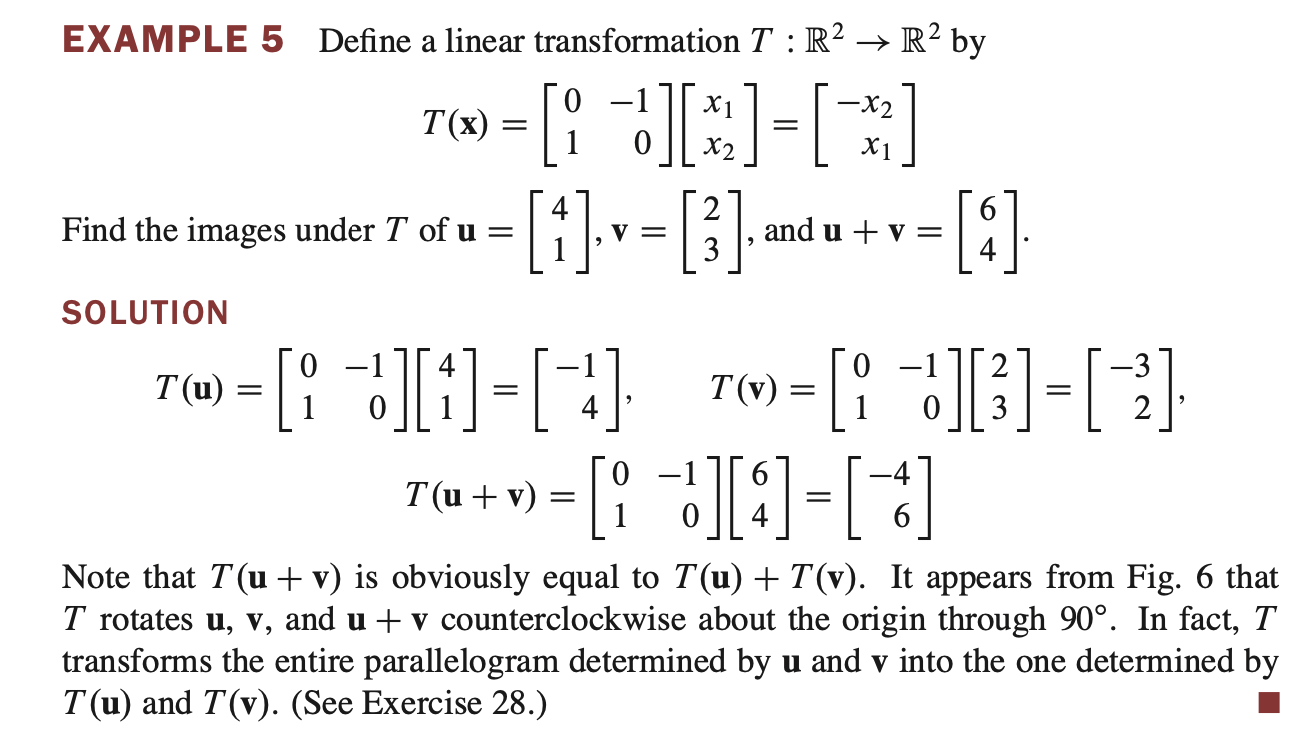
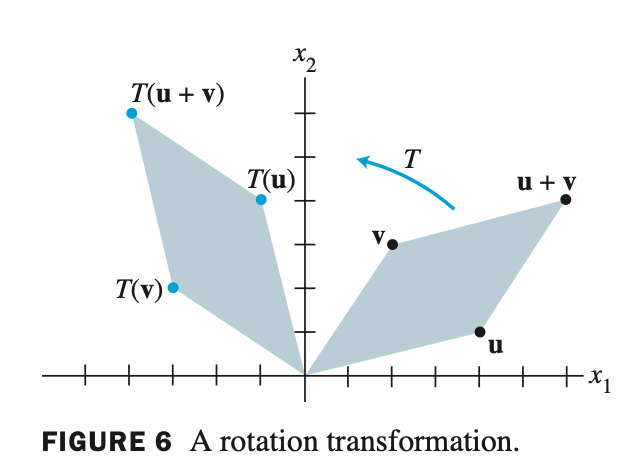
- linear transformation 을 통해 각도가 회전되었다.
$T(\mathrm{u + v})$ 가 $T(\mathrm{u}) + T(\mathrm{v})$ 를 만족하는 linear 임을 확인할 수 있다.