
Linear Algebra - 2.4 Partitioned Matrices

Linear Algebra - 2.4 Partitioned Matrices
Linear Algebra 시리즈 (12 / 33)
- Linear Algebra - 1.1 Systems of Linear Equations
- Linear Algebra - 1.2 Row Reduction and Echelon Forms
- Linear Algebra - 1.3 Vector Equations
- Linear Algebra - 1.4 The Matrix Equation Ax=b
- Linear Algebra - 1.5 Solution Sets of Linear Systems
- Linear Algebra - 1.6 Linear Independence and Linear Dependence
- Linear Algebra - 1.7 Introduction to Linear Transformation
- Linear Algebra - 1.8 The Matrix of a Linear Transformation
- Linear Algebra - 2.1 Matrix Operations
- Linear Algebra - 2.2 The Inverse of Matrix
- Linear Algebra - 2.3 Characterizations of Invertible Matrices of
- Linear Algebra - 2.4 Partitioned Matrices
- Linear Algebra - 2.5 Matrix Factorizations, LU Decomposition
- Linear Algebra - 2.6 Subspaces of $\mathbb{R}^n$
- Linear Algebra - 2.7 Dimension and Rank
- Linear Algebra - 3.1 Introduction to Determinants
- Linear Algebra - 3.2 Properties of Determinants
- Linear Algebra - 3.3 Cramer's Rule, Volume, And Linear Transformations
- Linear Algebra - 4.1 Eigenvectors and Eigenvalues
- Linear Algebra - 4.2 The Characteristic Equation
- Linear Algebra - 4.3 Diagonalization
- Linear Algebra - 4.4 Eigenvectors And Linear Transformations
- Linear Algebra - 4.5 Complex Eigenvalues
- Linear Algebra - 5.1 Inner Product And Orthogonality
- Linear Algebra - 5.2 Orthogonal Sets
- Linear Algebra - 5.3 Orthogonal Projections
- Linear Algebra - 5.4 The Gram-Schmidt Process (그람 슈미츠 과정)
- Linear Algebra - 5.5 Least-Square Problems
- Linear Algebra - 6.1 Diagonalization of Symmetric Matrices
- Linear Algebra - 6.2 Quadratic Forms
- Linear Algebra - 6.3 Constrained Optimization
- Linear Algebra - 6.4 SVD, The Singular Value Decomposition
- Linear Algebra - 6.5 Reduced SVD, Pseudoinverse, Matrix Classification, Inverse Algorithm

용어 정리
- Partitioned Matrix or Block Matrix (분할 행렬 or 블록 행렬)
- Column-row expansion AB (AB의 열-행 확장)
- Inverse of partitioned matrix (분할 행렬의 역행렬)
Partitioned Matrix or Block Matrix - 분할 행렬 or 블록 행렬
- matrix 가 주어졌을 때 임의로 row 와 column 을 나눈다.
이를 submatrix 로 표현한 것을 partitioned matrix (분할 행렬) 또는 block matrix (블록 행렬)이라고 한다.
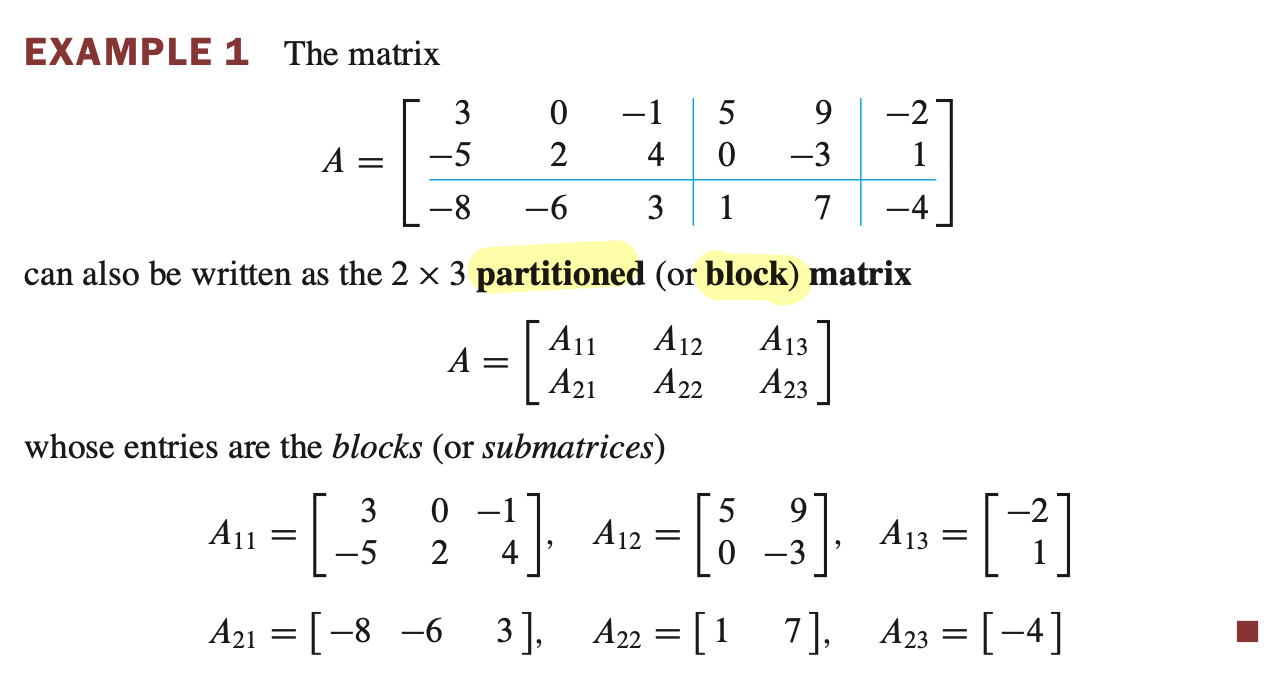
- 여기서 A 행렬은 총 6개의 파티션으로 나누어졌고, 각 파티션들의 인덱스들은 일반 행렬의 요소들 처럼 취급된다. 따라서 같은 형식으로 파티션이 나뉘어진 행렬들은 똑같은 행렬 연산 (행렬 곱셈, 행렬 덧셈)이 가능하다.
Multiplication of Partitioned Matrix - 분할 행렬의 곱셈
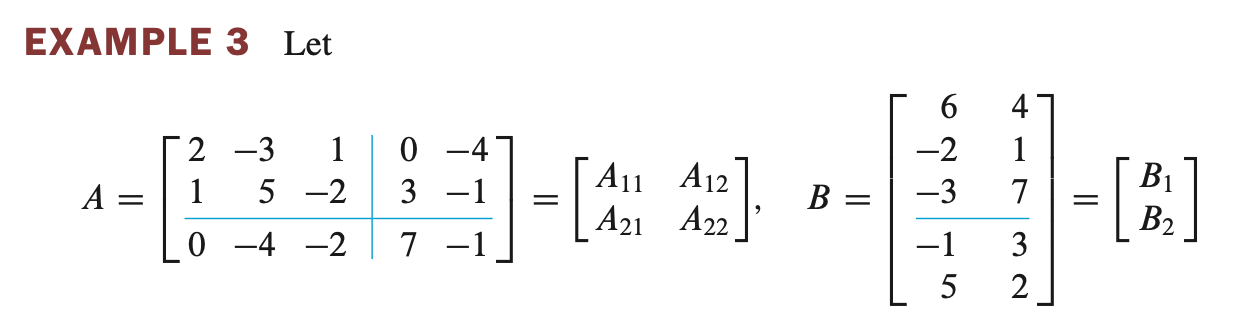

- 각각의 block을 단일 entry로 다뤄서 기존의 matrix multiplication 을 이용하면 된다.
- 이렇게 AB 행렬과 같이 파티션이 나누어져 곱연산이 가능한 형태를 comfortable 이라고 한다.
Theorem10. Column-Row Expansion of AB
If $A$ is $m \times n$ and $B$ is $n \times p$, then
\(AB = \begin{bmatrix} col_1(A) & col_2(A) & \dots & col_n(A) \end{bmatrix} \begin{bmatrix} row_1(A) \\\ row_2(A) \\\ \dots \\\ row_n(A) \end{bmatrix}\)
\(= col_1(A)row_1(B) + \dots + col_n(A)row_n(B)\)

- $m \times n$ 분할 행렬 $A$ 와 $n \times p$ 분할 행렬 $B$ 를 곱하면 $m \times p$ 행렬이 만들어진다.
Inverses of Partitioned Matrix - 분할 행렬의 역행렬
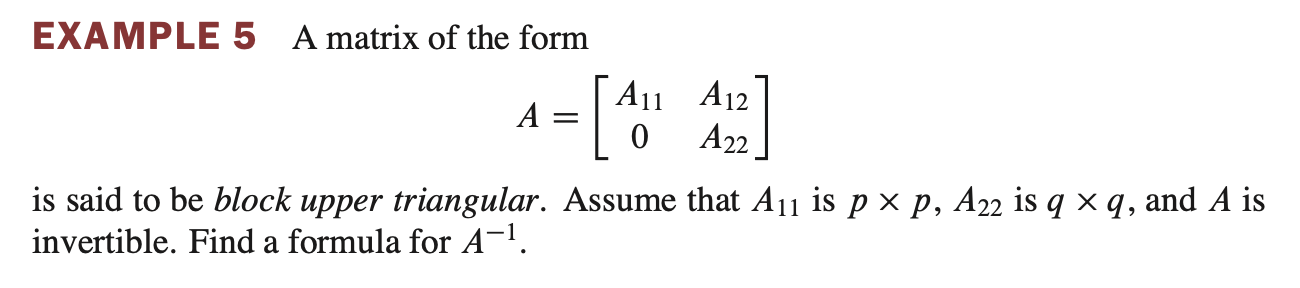
- $A$ matrix 의 form이 block upper triangular 로 주어지고 $A_11$ 은 $p \times p$, $A_22$ 는 $q \times q$ 이고 $A$ 가 invertible 이라고 가정할 때 $A^{-1}$ 을 찾아보자.
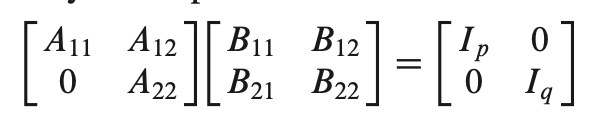
- 여기서 B 는 A 의 역행렬이다. Multiplication을 적용하면 4개의 식이 도출된다.
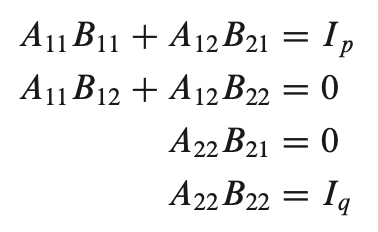
- 위 식을 $A^{-1}$ 를 찾을 수 있다.
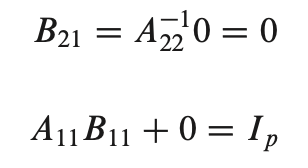
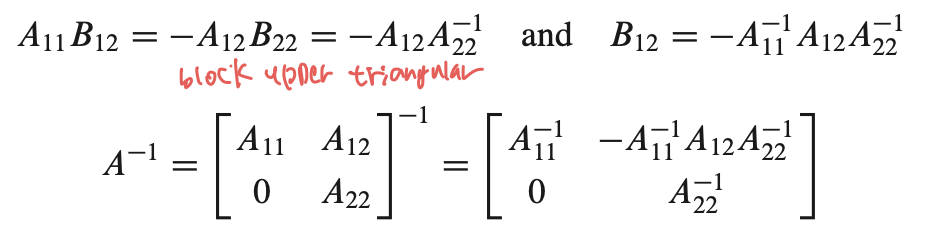
- $B_{11}, B_{12}, B_{21}, B_{22}$를 구했으므로 B 행렬(A의 역행렬)을 표현할 수 있다.
이 기사는 저작권자의 CC BY 4.0 라이센스를 따릅니다.