
Linear Algebra - 2.3 Characterizations of Invertible Matrices of

- Linear Algebra - 1.1 Systems of Linear Equations
- Linear Algebra - 1.2 Row Reduction and Echelon Forms
- Linear Algebra - 1.3 Vector Equations
- Linear Algebra - 1.4 The Matrix Equation Ax=b
- Linear Algebra - 1.5 Solution Sets of Linear Systems
- Linear Algebra - 1.6 Linear Independence and Linear Dependence
- Linear Algebra - 1.7 Introduction to Linear Transformation
- Linear Algebra - 1.8 The Matrix of a Linear Transformation
- Linear Algebra - 2.1 Matrix Operations
- Linear Algebra - 2.2 The Inverse of Matrix
- Linear Algebra - 2.3 Characterizations of Invertible Matrices of
- Linear Algebra - 2.4 Partitioned Matrices
- Linear Algebra - 2.5 Matrix Factorizations, LU Decomposition
- Linear Algebra - 2.6 Subspaces of $\mathbb{R}^n$
- Linear Algebra - 2.7 Dimension and Rank
- Linear Algebra - 3.1 Introduction to Determinants
- Linear Algebra - 3.2 Properties of Determinants
- Linear Algebra - 3.3 Cramer's Rule, Volume, And Linear Transformations
- Linear Algebra - 4.1 Eigenvectors and Eigenvalues
- Linear Algebra - 4.2 The Characteristic Equation
- Linear Algebra - 4.3 Diagonalization
- Linear Algebra - 4.4 Eigenvectors And Linear Transformations
- Linear Algebra - 4.5 Complex Eigenvalues
- Linear Algebra - 5.1 Inner Product And Orthogonality
- Linear Algebra - 5.2 Orthogonal Sets
- Linear Algebra - 5.3 Orthogonal Projections
- Linear Algebra - 5.4 The Gram-Schmidt Process (그람 슈미츠 과정)
- Linear Algebra - 5.5 Least-Square Problems
- Linear Algebra - 6.1 Diagonalization of Symmetric Matrices
- Linear Algebra - 6.2 Quadratic Forms
- Linear Algebra - 6.3 Constrained Optimization
- Linear Algebra - 6.4 SVD, The Singular Value Decomposition
- Linear Algebra - 6.5 Reduced SVD, Pseudoinverse, Matrix Classification, Inverse Algorithm

용어 정리
- Invertible Linear Trnasformation (역선형 변환)
Theorem8.
Let $ A $ be a square $n \times n$ matrix. Then the following statements are equivalent. That is, for a given $A$, the statements are either all true or all falsea. $A$ is an invertible matrix.
b. $A$ is row equivalent to the $n \times n$ identity matrix.
c. $A$ has $n$ pivot positions.
d. The equation $A\mathbf{x} = 0$ has only the trivial solution.
e. The columns of $A$ form a linearly independent set.
f. The linear transformation $\mathbf{x} \mapsto A\mathbf{x}$ is one-to-one.
g. The equation $A\mathbf{x} = \mathbf{b}$ has at least one solution for each $\mathbf{b}$ in $ \mathbb{R}^{n} $ .
h. The columns of $A$ span $ \mathbb{R}^{n} $.
i. The linear transformation $\mathbf{x} \mapsto A\mathbf{x}$ maps $ \mathbb{R}^{n} $ onto $ \mathbb{R}^{m} $ .
j. There is an $n \times n$ matrix $C$ such that $CA = I$.
k. There is an $n \times n$ matrix $D$ such that $AD = I$.
l. $ \mathbb{A}^{T} $ is an invertible matrix.
- $A$ 가 invertible 이면 위 조건을 다 만족하고, not invertible 이면 위 조건을 다 만족하지 않는다.
- $A\mathbf{x} = 0$ 은 trivial solution만을 갖으므로 linearly independent 이며 n pivot position을 만족한다.
n개의 pivot position을 만족하므로 one-to-one 도 성립하고 $A$ 는 solution이 있으므로 $A$는 $ \mathbb{R}^{n} $ space에 span 하며 이로 인해 onto 역시 성립하게 된다.
- 부연 설명을 하면, onto 이기 위해서는 Ax=b 의 식에서 임의의 b in Rn 이 모두 해를 가져야한다. 즉 A 의 모든 row 가 pivot 을 가지고 있으며, invertible 한 것이다.
- invertible 하기에 solution 이 unique 하므로 one-to-one 이 성립된다. 반대로 one-to-one 일 경우 invertible 하다.
예제
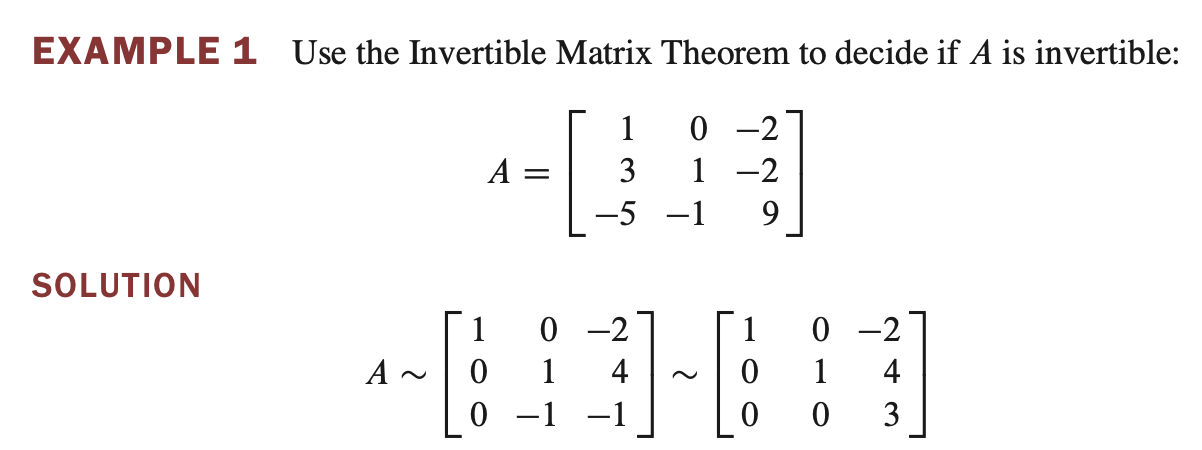
- R3 공간의 3x3 행렬이고 scalar multiplication 이 없고 눈대중으로 row reduction 을 해도 inconsistent 한 row 가 없으므로 3개의 pivot postion 을 가지고 trivial solution 임을 확인할 수 있다.
- 따라서 linearly independent 하므로 A matrix 는 invertible 하다고 볼 수 있다.
Invertible Linear Transformation - 역선형 변환
- x 에서 Ax 로 가는 선형변환이 있을 때, 다시 x 로 돌아오는 변환이 있으면 역선형변환이라고 한다.
- S 함수가 존재하는 경우에 T는 invertible 하다고 한다.
Theorem9.
Let $T$ : $\mathbb{R}^{n} \rightarrow \mathbb{R}^{n} $ be a linear transformation and let $A$ be the standard matrix for $T$ . Then $T$ is invertible if and only if $A$ is an invertible matrix. In that case, the linear transformation $S$ given by $S(\mathbf{x}) = \mathbb{A}^{-1}\mathbf{x}$ is the unique function satisfying equations (1) and (2)
- linear transformation은 항상 standard matrix 가 존재한다. $T$ 가 invertible 이면 $A$ (standard matrix) 도 invertible 하다. (역행렬을 가질 수 있음)
- 또 linear transformation $S$ 함수는 $S(\mathbf{x}) = \mathbb{A}^{-1}\mathbf{x}$ (1)과 (2) 에 대해 유일함수임을 만족한다.