
Jev in Depth - How It Differs from Transformers, Parallel Decisions, and the Sources of Its Speed
A closer look at the decisions TypeSafe's Jev makes, how its processing path differs from an autoregressive LLM, and what parallel questions and probability calibration mean for speed and software design.
- GPU Compute Units Deep Dive: CUDA Core, Tensor Core, and NPU
- How LLMs Work: A Guide for Game Developers
- VRAM Deep Dive: GPU Memory Hierarchy and LLM Model Loading
- Playing DOOM with Brain Cells — In-Depth Analysis of Biological Neural Computing: Present and Future
- The Complete LLM Guide for Non-Developers — How Planners, QA, and Marketers Can Use AI at Work
- Claude Mythos Preview Analysis — Cyber Capabilities, Alignment Risks, and Project Glasswing
- Nerfed Claude — From Transformer Internals to Submarine Patches, Hallucinations, and Token Inflation
- Jev in Depth - How It Differs from Transformers, Parallel Decisions, and the Sources of Its Speed
- Jev is a TypeSafe model that reads a state described in natural language and returns decisions and probabilities for developer-defined choices, levels, and truth judgments.
- Transformer is a neural network architecture, while autoregression is an output method. Jev's differences should not be explained by claiming that it does not use Transformers.
- The core of the publicly described speed advantage is avoiding long, token-by-token text generation and evaluating independent questions about the same state in parallel within one request.
- A correctly typed response and a correct judgment are different things. Distinguish probability, confidence, and thresholds, and validate them in the actual domain.


It Is Called Fast AI, but What Does It Make Faster?
Recent introductions to Jev often mention fast responses, low costs, and agent automation together. But treating Jev as simply “an LLM that writes answers very quickly” leads to a misunderstanding of how to use it. Jev is not a model for writing explanations or generating code.
The Jev discussed here is the System One decision model released by TypeSafe AI on September 15, 2026. It is not another service or community project with the same name. TypeSafe announcement
There is also evidence of the growing interest. In a September 18 post, Vercel reported that roughly 13% of paid AI Gateway teams had used Jev within its first 24 hours of availability. This is an observation within Vercel’s platform, however, not a measure of its share of the overall AI market or its long-term usage rate. Vercel adoption report
Four questions are worth examining: what Jev returns, how it relates to Transformers, why it is fast, and what it gives up to achieve that speed. I will explain these by comparing the official documentation, SDK implementations, actual integration projects, and external evaluation papers. The research cutoff is October 6, 2026, and the reference model is jev-1.13.0. This is not a hands-on benchmark measured through paid API calls.
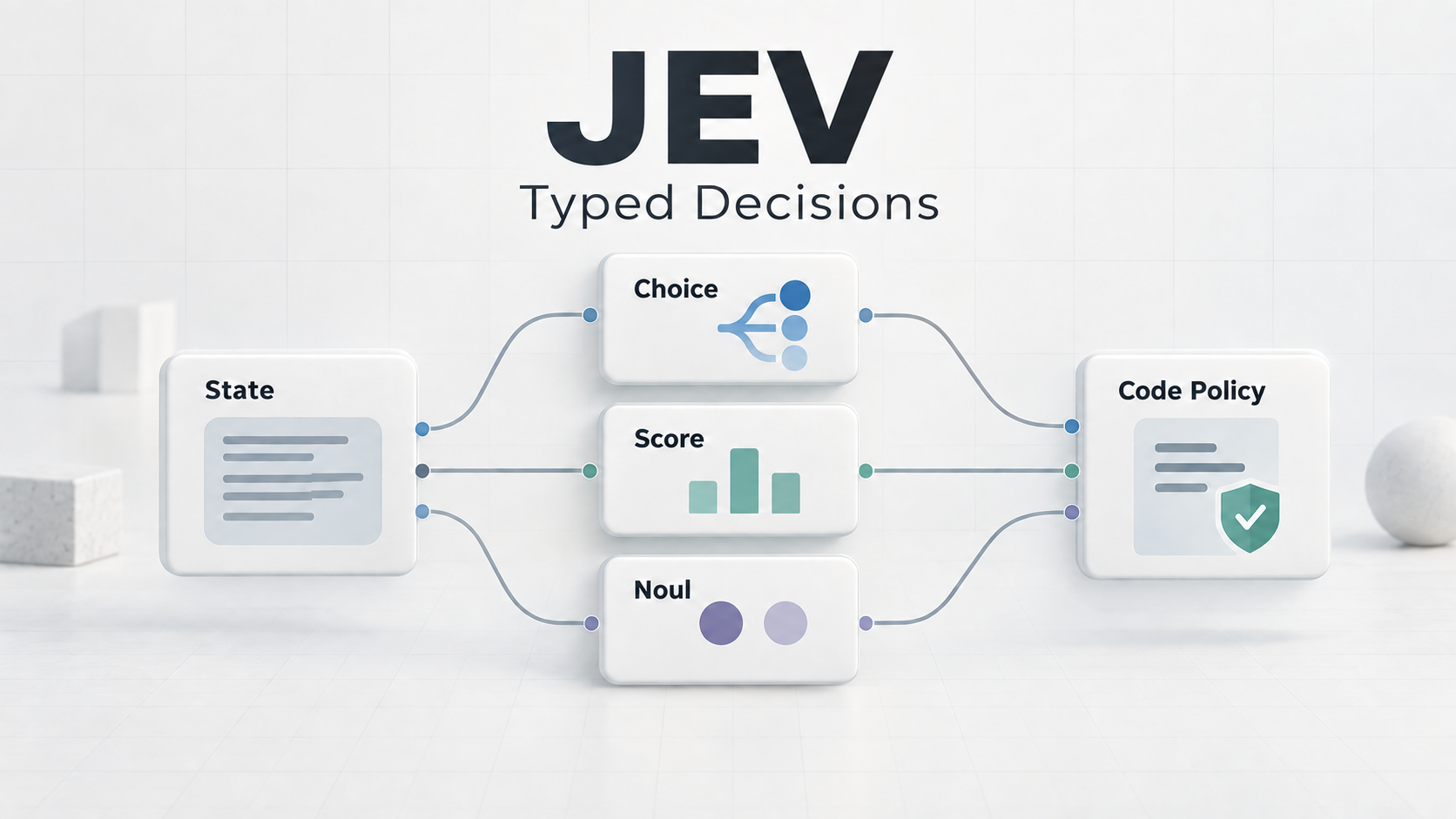
The cover is an AI-generated conceptual illustration created for this article. It depicts three question types evaluated from one state, with application policy combining the results. It is not an official logo, a product screenshot, an internal neural network diagram, or a graph of measured probabilities.
1. Jev’s Role: Returning Decisions Instead of Writing Sentences
The Input Is a State; the Output Is a Constrained Answer
With a typical chatbot, you might ask, “How should we handle this inquiry?” With Jev, you provide both the state needed to handle it and the criteria for making the decision.
For example, a game bug report can be organized as follows.
state: information needed for the judgment, such as the report, runtime environment, and relevant logsquestions: “Which team owns this issue?”, “How severe is it?”, and “Are reproduction steps included?”criteria: the available issue categories and the definition of each severity level
The decisive element is criteria. Rather than instructing the model to “handle it appropriately,” you first define the answer space the application accepts and what each answer means. Code reads Jev’s result and selects a review queue or responsible team. Creating the actual ticket or changing permissions is the responsibility of separate execution code.
TypeSafe calls this kind of model System One. The distinction is that it understands natural-language input but returns typed decisions and probabilities instead of generating free-form answers, code, or explanations of its reasoning. Jev currently accepts text input, supporting strings, JSON objects, and arrays of text. Images, audio, and video cannot be supplied directly. Official System One explanation
The name System One comes from the psychological concept of System 1, associated with fast, intuitive judgments. It does not mean that the model implements a thought process identical to human intuition.
Three Question Types
| Type | Judgment to Delegate | Meaning of the Return Value |
|---|---|---|
| Choice | Which of the defined candidates is it? | Selected candidate, probability for each candidate, and confidence |
| Score | Which of the descriptively defined levels best fits? | Weighted average of level probabilities, distribution, and confidence |
| Noul | Is the proposition true? | A floating-point value from 0 to 1 representing the probability of truth |
Reading Noul as a Boolean discards important information. 0.51 and 0.99 both lean toward true, but there is no reason to treat them identically in an automation policy. Conversely, a Score of 1.4 is not “a 140% probability of truth”; it is the mean of a distribution spanning several levels. Choice, Score, Noul
Choice candidates can change with each request. Its interface differs from a task-specific classification API that only outputs fixed labels learned during training. Candidate names and descriptions must carry meaning; question IDs used to match responses are not used as inputs to the model’s judgment. Merely naming an ID is_dangerous is insufficient if the question itself omits the definition of danger. Primitives documentation
2. How Does It Differ from a Transformer?
First, Compare at the Same Level
Transformer is a neural network architecture, while Jev is a model with a particular training objective and decision interface. Comparing “Transformer versus Jev” as though they were two alternative neural network architectures is therefore inaccurate.
The following levels need to be separated.
| Level | Question | Example |
|---|---|---|
| Neural network architecture | What operations combine information across inputs? | Transformer attention and layered structure |
| Inference and output method | What dependencies govern how the answer is produced? | Autoregressive token generation, evaluation of classification values |
| Training objective | What results is the model trained to produce well? | Next-token prediction, preference optimization, decisions and probability calibration |
| Product interface | What does the calling program send and receive? | Conversation messages and text, state and typed answers |
The comparison most directly related to speed is primarily at the second level. Even within the Transformer family, sequentially generating long text and obtaining judgments about defined candidates perform different tasks.
The original Transformer paper proposed an architecture centered on attention rather than recurrence. That does not mean every model built with Transformers generates sentences one token at a time. BERT is a well-known example that attaches output layers to bidirectional Transformer representations to perform tasks such as language inference. Transformer and autoregressive text generation are not synonyms. Attention Is All You Need, Original BERT paper
How Much of Jev’s Internal Neural Network Is Public?
TypeSafe describes an RLCD approach that trains a pretrained language model into a decision model. However, the public materials examined do not disclose the base model name, parameter count, attention arrangement, layer count, or specific output-head structure. TypeSafe AI primer
The following two statements must therefore be distinguished.
Supported description: Jev is designed to return structured decisions and probabilities instead of conventional autoregressive generation of free-form text.
Unsupported description: Jev does not use Transformers at all and performs only one matrix multiplication through a classification head of a specific size.
The processing diagrams and cost equations in this article are also conceptual models explaining publicly described behavior. They are not blueprints reverse-engineered from a private neural network.
3. Where Its Speed Comes From
3.1 Avoiding Token Dependencies in Long Outputs
For a GPT-style autoregressive language model generating an answer \(y_1,\ldots,y_N\), the probability can be written as follows.
\[P(y\mid x)=\prod_{t=1}^{N}P(y_t\mid x,y_{<t})\]Later tokens depend on the tokens actually selected earlier. This is why the prefill stage that processes the input is followed by a decode stage that produces answer tokens. Parallelizing matrix operations inside a Transformer and determining all future output tokens before they have been selected are different problems.
A KV cache reduces redundant computation by reusing the keys and values of tokens already processed. It does not remove the dependency of the next token on the preceding output. The claim that “a cache lets a long answer be generated all at once” is incorrect. Hugging Face explanation of KV caches
Classifying a bug report does not require waiting for an entire answer like this.
1
2
3
After reviewing the report, this appears to be a crash issue rather than a rendering issue.
Its severity is high, and reproduction information is available because the user described the repeated steps.
It should therefore be forwarded to the responsible team.
The program only needs the issue category, severity, and reproduction information. Jev returns answers of the defined types rather than an explanation. Avoiding a path that writes answers or probabilities one token at a time is the first source of speed. Parallel sampling in the Jev announcement
Of course, the HTTP response contains JSON strings and numbers. “Does not generate text” means it does not compose an answer like a free-text generation model; it does not mean the network response contains no characters or output bytes.
3.2 Evaluating Multiple Questions About the Same State in Parallel
Suppose we want to determine the category, severity, and reproduction information for one bug report. If all three questions can be answered from the same report available at the outset, there is no reason to wait for the first answer before sending the second question.
The difference in the diagram depends on the absence of result dependencies between questions. Applications can also execute ordinary LLM calls in parallel. Jev’s interface bundles one state and multiple typed questions into a single request so that the questions can be evaluated individually and in parallel. They do not read one another’s answers and reason through them sequentially. How multiple questions are evaluated
For example, a task that “fetches additional records from a log server and then determines the cause” cannot finish in one step. The input for the second judgment does not exist until those additional logs arrive. Forcing parallelism onto tasks with necessary dependencies undermines accuracy before it improves speed.
TypeSafe’s speculative fan-out describes a pattern in which multiple narrow questions for possible branches are evaluated together upfront, and code later uses only the results it needs. This reduces the round trips needed to construct questions after a classification result, but unused questions still incur computation and input costs. Speculative fan-out
3.3 Reducing Repeated State Transmission and Request Round Trips
Including the same long log in multiple separate requests repeats network round trips and input costs. Jev’s official documentation states that a request’s state is received once and shared across all its questions. Adding a question increases the input tokens for that question, but the state is not billed again for every question within the same request. Model context and state handling
For latency comparisons, it helps to conceptually separate the following components.
\[T_{\text{AR}}\approx T_{\text{network}}+T_{\text{prefill}}(L) +\sum_{t=1}^{N}T_{\text{decode}}(L+t)+T_{\text{parse}}\] \[T_{\text{decision}}\approx T_{\text{network}}+T_{\text{state}}(L) +T_{\text{evaluate}}(Q,K)+T_{\text{serialize}}\]Here, \(L\) is the input length, \(N\) is the number of generated tokens, \(Q\) is the number of questions, and \(K\) represents the workload determined by the candidate and level configuration. These are not exact runtime formulas for Jev’s implementation; they are analytical expressions for distinguishing repeated token-generation costs from decision-evaluation costs. Queueing, retries, and tool execution time must be added separately.
The important point is that \(T_{\text{state}}\) and \(T_{\text{evaluate}}\) remain in the second expression. Computation is still required to process the meaning of the input, and the costs of long states and complex questions do not disappear. The expressions do not imply that “latency stays constant even with infinitely many questions” or that “no GPU computation takes place.”
3.4 Does JSON Mode Not Achieve the Same Effect?
Requesting JSON instead of free-form prose can eliminate unnecessary explanations. Schema-enforcing constrained decoding also restricts invalid structures. However, restricting the output format and eliminating sequential token generation are separate optimizations. If an autoregressive model writes JSON, that JSON still consists of output tokens.
Conversely, existing language models can classify quickly by returning a short label or reading only the logits for candidates. BERT-style classifiers do not need to generate long sentences either. Jev’s distinction is not that “every other model must write slow prose.” It is offering request-defined decision criteria, a training objective that addresses probabilities, and a parallel interface for multiple questions as one service.
A speed advantage should not be generalized from model names alone when comparing a one-token classifier against a model producing lengthy reasoning. Model size, output length, inference settings, and network conditions must also be aligned to identify which costs were reduced.
4. What Does RLCD Train?
RLCD stands for Reinforcement Learning for Calibrated Decisions. TypeSafe describes it as an approach that trains a pretrained language model to return decisions and calibrated probabilities for software, rather than answers for people to read. Official RLCD overview
Separating the training objectives clarifies the difference. RLHF uses human preference feedback, while RLVR uses verifiable rewards, such as whether an answer is correct. RLCD emphasizes which decision is correct and how well the probability assigned to it reflects actual outcomes. These approaches do not have to be understood as mutually exclusive neural network architectures.
For example, a model that returns 0.99 whenever it happens to get an answer right despite insufficient evidence is dangerous for automation. Conversely, returning 0.50 every time makes it difficult to identify cases that need review. A good decision interface needs not only the ability to distinguish outcomes but also the ability to convey uncertainty as usable numbers.
This is called calibration. When enough cases predicted at 0.8 are collected, the corresponding event should occur in approximately 80% of them. It is a property of a group of predictions, not a guarantee that any individual request is correct. System One explanation of calibration
The public materials do not disclose RLCD’s specific loss function, reward formula, or training data composition and size. There is therefore no basis for asserting that it “minimizes the Brier score using this formula” or that “applying RLCD always makes probabilities accurate.” The publicly stated training objective must be distinguished from the quality of probabilities that needs validation in a real product.
5. Do Not Confuse Probability with Confidence
Choice: Selection Probability and How Concentrated the Distribution Is
Choice candidates have a probability distribution. Developers can read only the candidate with the highest probability or use the entire distribution in a policy.
For a number of choices \(n>1\), the official Choice confidence is calculated as follows.
\[c=\frac{p_{\max}-1/n}{1-1/n}\]Suppose the distribution over three candidates is (0.6, 0.3, 0.1).
The highest selection probability is 0.6, but the confidence is 0.4. This value normalizes how much the probability is concentrated on one candidate relative to a uniform distribution, so a confidence of 0.9 must not be read as 90% accuracy. Changing the number of candidates changes confidence even when the highest probability stays the same. Confidence definition
A concentrated distribution can still be wrong. When the model version, candidate configuration, or domain changes, do not simply retain existing thresholds; check the actual error rate among automatically handled cases again.
Score: The Mean of a Distribution over Levels
Score’s criteria is an array of descriptions ordered from lower to higher levels. Defining three levels gives indices 0, 1, 2, and the returned score is as follows.
For example, level probabilities of (0.1, 0.4, 0.5) give a score of 1.4. It is not automatically normalized to a 0–1 range, nor is it an estimate of an exact continuous measurement such as “the actual outage lasted 1.4 hours.” Score return value
Score confidence summarizes how far the distribution spreads from the modal level. It does not apply the Choice formula unchanged. Each level description should also independently define the state it represents, rather than referencing a neighboring description with wording such as “more severe than the previous level.”
Noul: Code Is Responsible for Turning Probability into Policy
Noul’s .noul is the probability that the proposition is true. It has no separate .confidence field. For example, the probability returned for “Are the reproduction steps sufficient?” can be used to choose among three policies: forward automatically / request more information / human review. Official Noul documentation
The model does not decide whether the boundary should be 0.5 or 0.9. The cost of an incorrect automated action differs from the cost of human review. In particular, permission and explicit approval for actions such as payments, account resets, or file deletion must be checked outside the model’s probabilities. A model saying that an action “is probably safe” and a user authorizing that action are different facts.
6. The SDK Makes the Division of Responsibilities Clearer
A Game Bug Report Evaluated with Three Questions
The official Python package is typesafe-sdk, and its import name is typesafe_sdk. The example below follows the calling convention of Python SDK 0.7.2. A key must be set in the TYPESAFE_API_KEY environment variable, and running it makes an external API call that incurs costs. I did not execute it or obtain a response while writing this article. Official Python SDK
The Korean input and criteria are intentionally preserved because this example is an evaluation scenario for Korean bug reports.
1
2
3
4
5
6
7
8
9
10
11
12
13
14
15
16
17
18
19
20
21
22
23
24
25
26
27
28
29
30
31
32
33
34
35
36
37
38
39
40
41
42
43
44
45
46
47
48
49
50
51
52
53
54
55
56
from typesafe_sdk import Choice, Noul, Score, TypeSafeClient

state = {
  "report": (
    "전투가 끝나고 결과 화면으로 넘어갈 때 앱이 종료됩니다. "
    "같은 맵에서 전투를 다시 끝내면 똑같이 발생합니다. "
    "재접속하면 전투 기록은 남아 있습니다."
  ),
  "environment": {"platform": "Android", "build": "test-build"},
}

with TypeSafeClient() as client:
  result = client.system_one(
    model="jev-1.13.0",
    state=state,
    questions={
      "area": Choice(
        instructions="report에서 설명한 주된 문제 유형은 무엇인가?",
        criteria={
          "crash": "앱이 비정상적으로 종료되거나 응답하지 않는다.",
          "rendering": "앱은 동작하지만 화면의 표시나 시각 효과가 잘못된다.",
          "network": "서버 연결이나 통신 오류가 주된 문제이다.",
          "other": "위 유형에 해당하지 않거나 분류에 필요한 정보가 부족하다.",
        },
      ),
      "severity": Score(
        instructions="report에 적힌 증상을 플레이 방해 정도로 평가하라.",
        criteria=[
          "표시상의 문제이며 플레이 진행을 막지 않는다.",
          "일부 기능을 방해하지만 앱을 종료하지 않고 진행할 수 있다.",
          "앱 종료 또는 진행 불가로 플레이를 중단시킨다.",
        ],
      ),
      "has_steps": Noul(
        instructions="report에 문제가 발생하는 행동 순서가 적혀 있는가?",
        criteria={
          "true": "문제 발생 전 사용자가 수행한 행동이나 전환 순서를 설명한다.",
          "false": "증상만 설명하고 발생 전 행동 순서는 설명하지 않는다.",
        },
      ),
    },
  )

area = result.choices["area"]
severity = result.scores["severity"]
steps_probability = result.nouls["has_steps"].noul

# Illustrative thresholds. Evaluate on real Korean bug reports and adjust them.
if area.choice == "other" or area.confidence < 0.8:
  queue = "human_review"
elif steps_probability < 0.8:
  queue = "request_reproduction_details"
else:
  queue = f"qa_{area.choice}"

print(result.model, queue, severity.score)
Jev’s role in the example ends with three judgments about the same report. queue is a string selected by code, not evidence that a ticket was created. The report and policy boundaries were written for this example; no classification probabilities, response times, or output values have been fabricated.
has_steps also asks only whether “steps are described.” It does not guarantee that following those steps on a real device successfully reproduces the issue. A stronger conclusion requires an additional observation stage, such as checking logs or running a test.
Details to Watch in the Calling Interface
Choice’s criteria is an object keyed by candidate names, while Score uses an ordered array of descriptions. In Python, the response can be read separately through result.choices, result.scores, and result.nouls. There is no need to receive response JSON and execute it as code with eval(). Python question types, Python response implementation
For direct HTTP calls, send state, model, and questions to POST https://api.typesafe.ai/v1/systemone. The official JavaScript SDK is @typesafe-ai/sdk, and its method is named systemOne. This differs from Python’s system_one. HTTP API, Official JavaScript SDK
Vercel AI Gateway usage must also be distinguished from an ordinary text-generation API. As of the verification date, TypeScript AI SDK 7.0.128 and later uses experimental_decide and gateway.decisionModel('typesafe-ai/jev'). It is easy to confuse this with the previous name, experimental_evaluate, while the HTTP path remains /v1/evaluate. This is an early-stage product with changing API names, so check the official documentation for the version in use rather than copying an older example unchanged. Gateway Decision API
7. Where Does It Fit in Practice?
Jev usually has an impact at narrow decision points between generation and tool execution. Public projects help distinguish the model’s responsibilities from those of the surrounding code.
Model Routing and Evaluation Before Tool Execution
LangChain’s ModelRouterMiddleware classifies a user message against predefined criteria and then selects the generative model to use. Jev does not write the answer; it chooses which model should write it. The same integration’s AutoModeMiddleware evaluates registered tool calls and returns an error message instead of executing a call it judges risky. A human approval procedure still needs to be implemented separately. LangChain TypeSafe integration
The execution boundary is clearer when divided as follows.
Without the permission check in this diagram, a high model probability can be treated as authorization to execute. Jev helps make semantic judgments; it is not a permission system. Malicious instructions hidden in input data can also influence the model’s judgments, so typed output alone does not establish safety.
Browser Automation: Select an Action Candidate, Then Have the Executor Check It
browser-use/jev-ultrafast assigns numbers to observed DOM elements and sends questions about the action type and the target for each action in one request. If a click is selected, it uses the answer for the click target. When text input is needed, a separate small LLM generates the input string. This is not a setup in which Jev views a screenshot and freely generates coordinates or JavaScript. Project README, Request construction source
The public performance document says each version was compared three times on one Google Flights task. It demonstrates the existence of a fast demo, but does not show that interactions with every site can be handled at the same speed and success rate. The surrounding execution code also checks whether an observed node is still valid and clickable. Measurement scope and constraints
Context Compaction: Deciding What to Retain, Not Writing a New Summary
The community plugin fast-jev-compaction pairs tool calls with their results and uses Noul to evaluate whether each pair needs to be retained. Code chooses whether to preserve the original, shorten the result, or remove it. Jev does not write a new summary. Plugin source, Compaction branch implementation
Importantly, the state used for evaluation does not contain the full bodies of the tool results. It uses information such as result length and success status alongside conversation and call content. Describing this as “reading everything and perfectly preserving only the important facts” would therefore be incorrect. Leaving retained original text unchanged is not the same as making the entire compaction process lossless. State construction source
In Games, It Fits Higher-Level Decisions Better Than Frame Logic
TypeSafe’s Doom example uses structured textual game state, not images. It also does not claim to play better than a rule-based bot. Conditions of the Doom example
For game development, evaluating high-level NPC action candidates or classifying player reports are natural possibilities. This is, however, a design interpretation of potential applications, not a report that Jev has already been integrated into this blog’s game project. There is no reason to move tasks that code can calculate exactly—collision handling, cooldowns, damage calculations, or per-frame movement—to an external model. Even a response of a few hundred milliseconds is on a different time scale from the approximately 16.7ms budget of one frame at 60fps.
8. Benchmarks: What Was Measured, and What Is Still Unknown?
The Company’s 193.6× and 444.6× Figures
TypeSafe’s launch post presents figures of 193.6× faster and 444.6× cheaper. These are results from four workflow evaluations configured by the company, not guarantees for every task or an SLA. Other LLMs are connected through wrappers that make them output probabilities. The reference responses are the average of GPT-6 Astra and Claude Fable 5.1, rather than human ground-truth labels. The company also discusses evaluation bias and the possibility of smaller gains in real-world environments. Company evaluation conditions, Public workflow evaluations
A service that needs only one decision label and a comparison service that generates probabilities for multiple candidates produce different amounts of output. When quoting these numbers, read how the same final task was performed in terms of calls and output as well.
The same announcement’s “zero hallucinations” is a value derived from schema-conformance guarantees, not a measurement of error-free semantic judgments. It remains possible to misclassify a network issue using the valid label crash. Type guarantees and chart methodology
Low Latency and Cost in an External Evaluation
Evaluating and Benchmarking the System One Model Jev, released on September 29, evaluated jev-1.13.0 across 37 datasets. Its main evaluation comprised 346,009 requests, costing $9.15, with a mean client-side latency of 0.36 seconds. This measurement included network time and used 32 concurrent requests. The open-weight comparison models were evaluated by reading candidate logits without reasoning. Paper Sections 4.7 and 5
This measurement supports the finding that short decision tasks can have low costs and latency. It does not independently reproduce the company’s 193.6× figure under the same conditions. Nor does it stand in for GPU-side inference time, latency when calling from Korea, or long-term operational P95 latency.
Probabilities Need Different Validation for Different Tasks
In the same paper, the pooled ECE for Choice was 0.028, while the ECE for multi-label Noul was 0.168. ECE summarizes, by bins, the difference between predicted probabilities and the actual frequency of the corresponding event. Choice is compared with how often the selected candidate is correct; Noul is compared with the observed frequency of yes outcomes. Numbers from different tasks and aggregation conditions must not be combined into one “reliability” score. On UNFAIR-ToS, micro-F1 was 0.499 at a fixed 0.5 threshold and 0.748 with thresholds tuned on training data. Paper Section 4.3
A separate Sys1Cal-v1 study released on September 28 expressed 92 synthetic problems with known ground-truth probabilities in 365 forms. It reports that probabilities can be inconsistent across Choice, Noul, Score, and different phrasings of the same proposition. The paper’s 0.978 figure is not 97.8% general accuracy; it is a measure of compatibility between uncertainty intervals and ground-truth probabilities. Sys1Cal-v1 paper
Both external studies are still preprints, and their evaluation objectives differ. The first study’s general classification results and the second study’s synthetic probability problems cannot be reduced to simple results for or against the product. The practical conclusion is not “probabilities make immediate execution safe,” but that probabilities, thresholds, and review policies must be evaluated together on your own tasks.
9. Boundaries to Retain with Jev 1.13
Weaknesses Disclosed by the Product Itself
TypeSafe’s October 2 review document identifies the following weaknesses.
- Mathematics, counting, exact numerical comparisons, and date comparisons
- Double negation and indirect judgments requiring multiple steps
- Long states containing substantial irrelevant content
- Inputs containing malicious instructions, and contradictory instructions and criteria
- Response changes caused by the order of Choice candidates
- Free-text generation tasks
The most direct design principle is to delegate semantic judgments to the model while keeping exact operations in code. Do not combine “Does this look like a risky request?” and “Does the transaction amount exceed the limit?” into one model question. The latter can be answered by comparing numbers already available. Independent question evaluation also does not imply immunity to long, irrelevant states. Official known issues for Jev 1.13
Current Input and Pricing Limits
| Item | Official Documentation as of 2026-10-06 |
|---|---|
| Version | jev-1.13.0; jev-latest and jev-preview currently point to the same version |
| Input | Text only |
| Request context | 64k tokens in total across the state and all questions |
| Individual question context | 32k tokens in total for the state and the longest question |
| Pricing | $0.042 per million input tokens; output is free |
| Stated throughput limits | 100K tokens / 80 requests per second; subject to change |
Free output is a pricing policy. It does not mean that output computation is physically free. Fitting within the context limit also does not guarantee accuracy at the maximum length. The documentation states that English is the primary training language and the most accurate, so Korean operational data requires separate validation. Current model card
jev-latest changes the version it points to when a new model is released. For a product with evaluated thresholds, it is preferable to pin the version ID and record the model version in responses. Pricing, limits, and SDK APIs also change over time; the numbers in this article should not be read as permanent specifications.
Measure the Entire Path Before Adoption, Not Just the Model
Real service latency adds state collection, networking, retries, additional information retrieval, and fallback time to the model’s response time. SDK backoff and retries increase latency for some requests, so measure the P95 of the full path separately, not just the average of successful individual calls. The scope of data transmission matters too. A statement that customer data is not used for training is not equivalent to a guarantee of zero storage or logging. Contracts and retention policies need to be checked separately. API errors and retries, Model data-handling description
At a minimum, an internal evaluation should include the following.
- Classification errors and probability calibration on real Korean examples and boundary cases
- The share of cases handled automatically at each threshold and the error rate among those cases
- Inputs with reordered candidates, negation, and malicious instructions embedded in the input
- Full-workflow P50 and P95 latency, and costs including retries and fallback
- Conservative review paths for timeouts, rate limits, and conflicting judgments
The second item determines the level of automation. Even if a higher threshold reduces errors, the operational benefit changes when most cases are sent to people. Error rates and the share of automatically handled cases must be considered together to judge how much a fast model accelerates the overall product.
Conclusion: Separate Generation from Decisions
The most important comparison for understanding Jev is not with Transformers themselves, but with a processing path that uses a text generator to make small judgments. Jev reads naturally defined criteria, narrows the output space to decision types, and bundles independent questions so that code can combine their results.
Generative models remain useful where writing answers, creating new code, or lengthy reasoning is needed. Decision models are worth considering where narrow judgments such as routing, classification, and evaluation repeat. Rather than asking only which model is smarter, first determine whether the program needs sentences or decisions. That is the starting point for evaluating Jev properly.
Research Scope and Primary Sources
The research covered official documentation on concepts, question types, confidence, the model card, and known issues; the Python and JavaScript SDKs and adapter; Gateway and LangChain integrations; the browser and compaction project sources; and two external evaluation papers. Internal weights or training code were not obtained, and I did not run the example projects or perform paid API benchmarks.
| What to Check | Primary Source |
|---|---|
| Launch purpose and company performance claims | TypeSafe launch post |
| Model concept and training objective | System One, RLCD overview |
| Types, probabilities, and specifications | Primitives, Confidence, Models |
| SDKs and comparison adapter | Python SDK, JavaScript SDK, System One adapter |
| External task evaluation | 37-dataset evaluation paper |
| External probability-semantics evaluation | Sys1Cal-v1 paper |
The comparison adapter connects other LLMs to the same question-and-response interface. It does not provide Jev’s weights or an open model implementation that reproduces RLCD and probability calibration. An identical API shape should not be confused with identical model behavior.