Addition and Subtraction of Matrices and Vectors of the Same Size
$A = \begin{bmatrix} 1 & 2 \ 3 & 4 \end{bmatrix}$ $B = \begin{bmatrix} 5 & 6 \ 7 & 8 \end{bmatrix}$
1
2
3
4
5
6
7
| A = np.array([[1,2], [3,4]])
B = np.array([[5,6],[7,8]])
C = A + B
C = A - B
|
- Vectors (1D arrays) can also be added and subtracted in the same way.
- As long as the shape is exactly the same, there are no problems.
Easily Creating Large Matrices
$ A = \begin{bmatrix} 2 & 1 & 0 & 0 & 0 \ -1 & 2 & 1 & 0 & 0 \ 0 & -1 & 2 & 1 & 0 \ 0 & 0 & -1 & 2 & 1 \ 0 & 0 & 0 & -1 & 2 \end{bmatrix} = \begin{bmatrix} 0 & 0 & 0 & 0 & 0 \ -1 & 0 & 0 & 0 & 0 \ 0 & -1 & 0 & 0 & 0 \ 0 & 0 & -1 & 0 & 0 \ 0 & 0 & 0 & -1 & 0 \end{bmatrix} + \begin{bmatrix} 2 & 0 & 0 & 0 & 0 \ 0 & 2 & 0 & 0 & 0 \ 0 & 0 & 2 & 0 & 0 \ 0 & 0 & 0 & 2 & 0 \ 0 & 0 & 0 & 0 & 2 \end{bmatrix} + \begin{bmatrix} 0 & 1 & 0 & 0 & 0 \ 0 & 0 & 1 & 0 & 0 \ 0 & 0 & 0 & 1 & 0 \ 0 & 0 & 0 & 0 & 1 \ 0 & 0 & 0 & 0 & 0 \end{bmatrix} $
- Here, extract each band into a 1D array using
np.ones and multiply by a scalar value.
For $k = -1$
$ b_1 = \begin{bmatrix} -1 & -1 & -1 & -1 \end{bmatrix} $
1
| b1 = (-1)*np.ones((4,))
|
For $k = 0$
$ b_2 = \begin{bmatrix} 2 & 2 & 2 & 2 & 2 \end{bmatrix} $
For $k = 1$
$ b_3 = \begin{bmatrix} 1 & 1 & 1 & 1 \end{bmatrix} $
- Then use the
np.diag function to turn these 1D arrays into matrices based on the maximum size (k=0) and add them together.
1
2
3
| A = np.diag(b1, k=-1) + np.diag(b2, k=0) + np.diag(b3, k=1)
print(A)
|
1
2
3
4
5
| [[ 2. 1. 0. 0. 0.]
[-1. 2. 1. 0. 0.]
[ 0. -1. 2. 1. 0.]
[ 0. 0. -1. 2. 1.]
[ 0. 0. 0. -1. 2.]]
|
Addition of Scalar and Matrix (r + A)
- Mathematically it doesn’t make sense, but it is possible in Python…
- It adds the scalar to every entry. Same goes for vectors.
1
2
3
4
5
6
7
| A = np.array([[1,2],[3,4]])
r = 5
result = r + A # = A + r
print(result)
|
Element-wise Multiplication and Division of Matrices (A * B) (A / B)
- Be careful, this is NOT matrix multiplication. It is completely different from
A @ B or np.matmul!! - Matrices with the same shape can be multiplied.
- It multiplies the entries at the same index and returns the result. Same for vectors.
1
2
3
4
5
6
| A = np.array([[1,2],[3,4]])
B = np.array([[5,6],[7,8]])
result = A * B # = B * A
print(result)
|
- Division works the same way.
- It doesn’t mean inverse matrix, it’s just simple element-wise division.
1
2
3
4
5
6
| A = np.array([[1,2],[3,4]])
B = np.array([[5,6],[7,8]])
result = A / B # = B / A
print(result)
|
1
2
| [[0.2 0.33333333]
[0.42857143 0.5 ]]
|
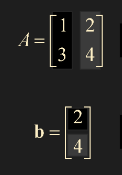
Element-wise Multiplication and Division of Matrix and Vector (A * b) (A / b)
- Be careful, this is NOT matrix-vector product.
- The shapes are different, but it’s possible…
- The number of columns in the matrix must equal the size of the vector. (
A.shape[1] == b.shape[0]) - For division,
A / b and b / A give different results because the operation method itself is different.
- Multiplication/division occurs between areas of the same color in the image above.
1
2
3
4
5
6
7
8
9
10
11
12
13
14
| A = np.array([[1,2],[3,4]])
b = np.array([2,4])
result = A * b
print(result)
result = A / b
print(result)
result = b / A # Think of it as b * (1 / A)
print(result)
|
1
2
3
4
5
6
7
8
| [[ 2 8]
[ 6 16]]
[[0.5 0.5]
[1.5 1. ]]
[[2. 2. ]
[0.66666667 1. ]]
|
Reconstructing Part of a Matrix Using Index Arrays
1
2
3
| A = np.array([[1,2,3,4,5],[6,7,8,9,10],[11,12,13,14,15],[-1,-2,-3,-4,-5]])
print(A)
|
1
2
3
4
5
6
7
8
| what_i_want = A[[1,2,0,3], : ]
# or
idx = [1,2,0,3]
what_i_want = A[idx, :]
print(what_i_want)
|
1
2
3
4
5
6
7
8
9
10
11
| # matrix A
[[ 1 2 3 4 5]
[ 6 7 8 9 10]
[11 12 13 14 15]
[-1 -2 -3 -4 -5]]
# index array
[[ 6 7 8 9 10]
[11 12 13 14 15]
[ 1 2 3 4 5]
[-1 -2 -3 -4 -5]]
|
1
2
3
4
5
| idx = [2,1]
what_i_want = A[idx, :]
print(what_i_want)
|
1
2
| [[11 12 13 14 15]
[ 6 7 8 9 10]]
|
- Extracting columns is also possible
1
2
3
4
5
| idx = [4,1,2]
what_i_want = A[:, idx]
print(what_i_want)
|
1
2
3
4
| [[ 5 2 3]
[10 7 8]
[15 12 13]
[-5 -2 -3]]
|
1
2
3
4
5
6
| idx_r = [2,3,0] # row
idx_c = [2,1,3] # column
what_i_want = A[idx_r, :][:, idx_c] # = A[:, idx_c][idx_r, :]
print(what_i_want)
|
1
2
3
| [[13 12 14]
[-3 -2 -4]
[ 3 2 4]]
|