
Numpy & Scipy - 1.2 Convenient Functions of Matrix
Numpy & Scipy - 1.2 Convenient Functions of Matrix
Numpy & Scipy Series (2 / 9)
- Numpy & Scipy - 1.1 Notation of Matrix and Vector, Matrix Input and Output
- Numpy & Scipy - 1.2 Convenient Functions of Matrix
- Numpy & Scipy - 1.3 Basic Manipulation of Matrices (1)
- Numpy & Scipy - 1.4 Basic Manipulation of Matrices (2)
- Numpy & Scipy - 1.5 Basic Manipulation of Matrices (3)
- Numpy & Scipy - 1.6 The Solution of Matrix Equation (General Matrices)
- Numpy & Scipy - 1.7 The Solution of Band Matrix
- Numpy & Scipy - 1.8 The Solution of Toeplitz Matrix and Circulant Matrix And How to Solve AX=B
- Numpy & Scipy - 1.9 Calculate Eigenvector and Eigenvalue of Matrix

eye / identity
np.eye: Function to fill 1s into a band.
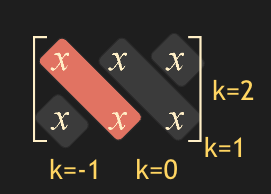
[[0. 1. 0.] [0. 0. 1.]]
np.identity: Function to create an identity matrix.
[[1. 0. 0.] [0. 1. 0.] [0. 0. 1.]]
tri
np.tri: Function to create a lower triangular matrix. Non-zero entry = 1.
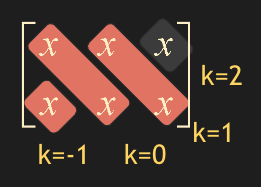
- Fills 1s in all bands where $k \ge$ band id, and 0s elsewhere.
0.00, 0.00, 0.00 1.00, 0.00, 0.00 1.00, 1.00, 0.00 1.00, 1.00, 1.00
zeros / ones / full
np.zeros: Fills a (row x column) matrix entirely with 0s.
0.00, 0.00, 0.00 0.00, 0.00, 0.00
np.ones: Fills a (row x column) matrix entirely with 1s.
1.00, 1.00, 1.00 1.00, 1.00, 1.00
np.full: Fills a (row x column) matrix entirely with a specified value.
( 1.00+0.00j), ( 1.00+0.00j), ( 1.00+0.00j) ( 1.00+0.00j), ( 1.00+0.00j), ( 1.00+0.00j) ( 1.00+0.00j), ( 1.00+0.00j), ( 1.00+0.00j)
random.rand
np.random.rand: Fills a (row x column) matrix with random values.- Only real matrices and
np.float64data types are allowed.
0.7852, 0.7524, 0.8531, 0.0095, 0.9326 0.8960, 0.6175, 0.6236, 0.5146, 0.4580 0.4606, 0.6550, 0.0049, 0.1367, 0.3998 0.3829, 0.7723, 0.0422, 0.0209, 0.1061 0.1148, 0.0447, 0.1126, 0.7619, 0.9044 0.4618, 0.1164, 0.1075, 0.7190, 0.7792 0.1036, 0.8590, 0.8889, 0.7100, 0.9618 0.6096, 0.9913, 0.7568, 0.6786, 0.5567
- Of course, you can express complex matrices using
random.rand.
Example 1
Create a 3x3 matrix where the real part is 0 and the imaginary part is 0i ~ 1i usingnp.random.rand.
( 0.00+0.33j) , ( 0.00+0.41j) , ( 0.00+0.52j) ( 0.00+0.11j) , ( 0.00+0.16j) , ( 0.00+0.45j) ( 0.00+0.92j) , ( 0.00+0.93j) , ( 0.00+0.81j)
This post is licensed under CC BY 4.0 by the author.