
Linear Algebra - 1.2 Row Reduction and Echelon Forms

- Linear Algebra - 1.1 Systems of Linear Equations
- Linear Algebra - 1.2 Row Reduction and Echelon Forms
- Linear Algebra - 1.3 Vector Equations
- Linear Algebra - 1.4 The Matrix Equation Ax=b
- Linear Algebra - 1.5 Solution Sets of Linear Systems
- Linear Algebra - 1.6 Linear Independence and Linear Dependence
- Linear Algebra - 1.7 Introduction to Linear Transformation
- Linear Algebra - 1.8 The Matrix of a Linear Transformation
- Linear Algebra - 2.1 Matrix Operations
- Linear Algebra - 2.2 The Inverse of Matrix
- Linear Algebra - 2.3 Characterizations of Invertible Matrices of
- Linear Algebra - 2.4 Partitioned Matrices
- Linear Algebra - 2.5 Matrix Factorizations, LU Decomposition
- Linear Algebra - 2.6 Subspaces of $\mathbb{R}^n$
- Linear Algebra - 2.7 Dimension and Rank
- Linear Algebra - 3.1 Introduction to Determinants
- Linear Algebra - 3.2 Properties of Determinants
- Linear Algebra - 3.3 Cramer's Rule, Volume, And Linear Transformations
- Linear Algebra - 4.1 Eigenvectors and Eigenvalues
- Linear Algebra - 4.2 The Characteristic Equation
- Linear Algebra - 4.3 Diagonalization
- Linear Algebra - 4.4 Eigenvectors And Linear Transformations
- Linear Algebra - 4.5 Complex Eigenvalues
- Linear Algebra - 5.1 Inner Product And Orthogonality
- Linear Algebra - 5.2 Orthogonal Sets
- Linear Algebra - 5.3 Orthogonal Projections
- Linear Algebra - 5.4 The Gram-Schmidt Process (그람 슈미츠 과정)
- Linear Algebra - 5.5 Least-Square Problems
- Linear Algebra - 6.1 Diagonalization of Symmetric Matrices
- Linear Algebra - 6.2 Quadratic Forms
- Linear Algebra - 6.3 Constrained Optimization
- Linear Algebra - 6.4 SVD, The Singular Value Decomposition
- Linear Algebra - 6.5 Reduced SVD, Pseudoinverse, Matrix Classification, Inverse Algorithm

용어 정리
- A nonzero row or column (0이 아닌 행과 열)
- A leading entry of row (행의 선행 성분)
- Echelon form (사다리꼴)
- Reduced echelon form (기약 사다리꼴)
- Uniqueness of the Reduced Echelon Form (기약 사다리꼴의 유일성)
- Row reduction algorithm (행 줄임 알고리즘)
- Solution of linear systems (소거법)
- general solution (일반 해)
- basic variables (기본 변수)
- free variables (자유 변수)
- Existence and Uniqueness Theorem (유일성과 존재)
A nonzero row or column - 0 이 아닌 행렬
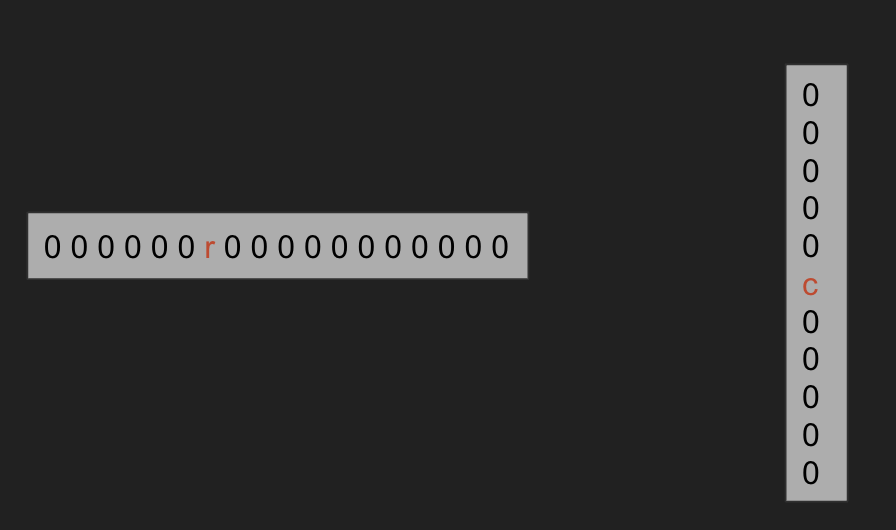
- 매트릭스에서 특정 row와 특정 column을 뽑아서 봤을 때 최소한 하나라도 0이 아니면 -> nonzero row, nonzero column 이라고 부른다.
A leading entry of row - 행의 선행성분
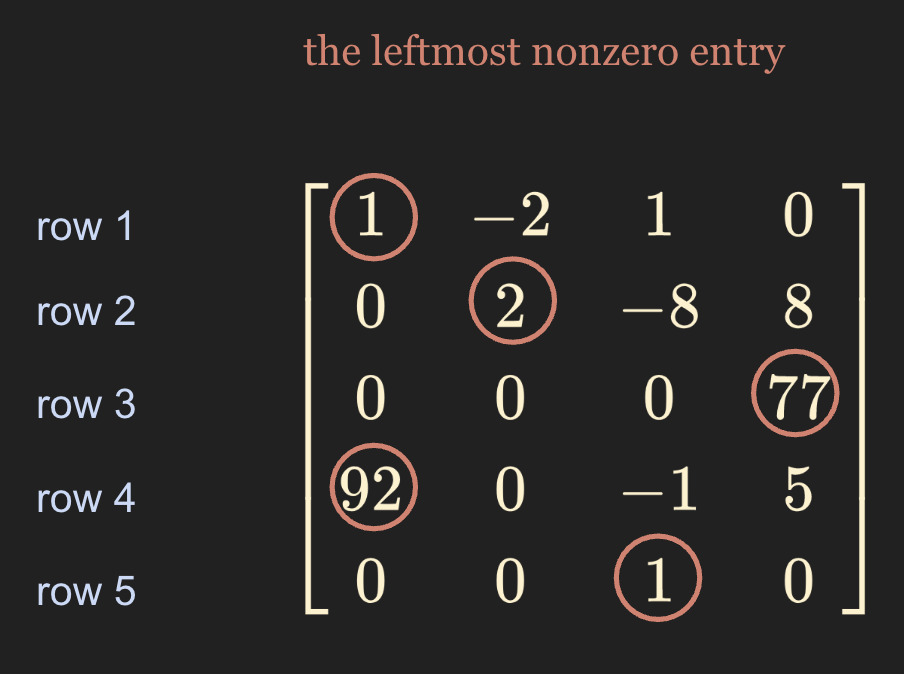
- the leftmost nonzero entry
- 0이 아닌 것 중에 제일 왼쪽에 있는 것이 leading entry에 해당됨
Echelon form - 사다리 꼴
- All nonzero rows are above any rows of all zeros.
모든 nonzero rows는 all zeros row 보다 위에 있다.
- Each leading entry of a row is in a column to the right of the leading entry of the row above it.
행의 leading entry는 위에 있는 leading entry보다 오른쪽 열에 있다.
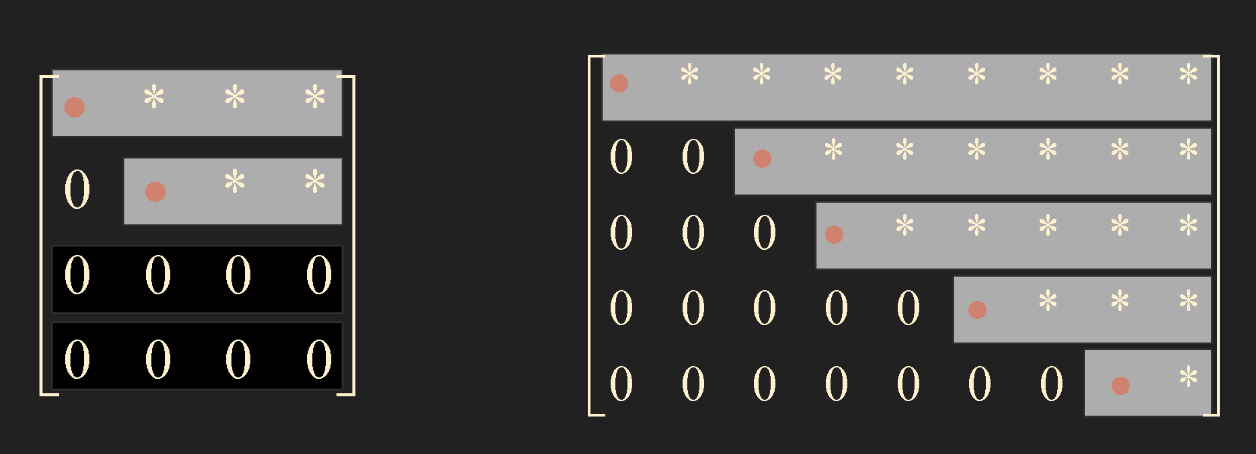
- 빨간 점이 leading entry 이다.
- 1 row 의 leading entry 보다 2 row 의 leading entry 가 오른쪽에 있으니 Echelon Form 이 맞다.
Reduced echelon form - 기약 사다리 꼴
- 1강에서 했던 내용임
- The leading entry in each nonzero row is 1.
nonzero 행에 있는 leading entry는 1이다.
- Each leading entry is the only nonzero entry in its column.
leading entry 가 1이어야하고, leading entry column은 leading entry 를 제외하곤 전부 0이되어야한다.
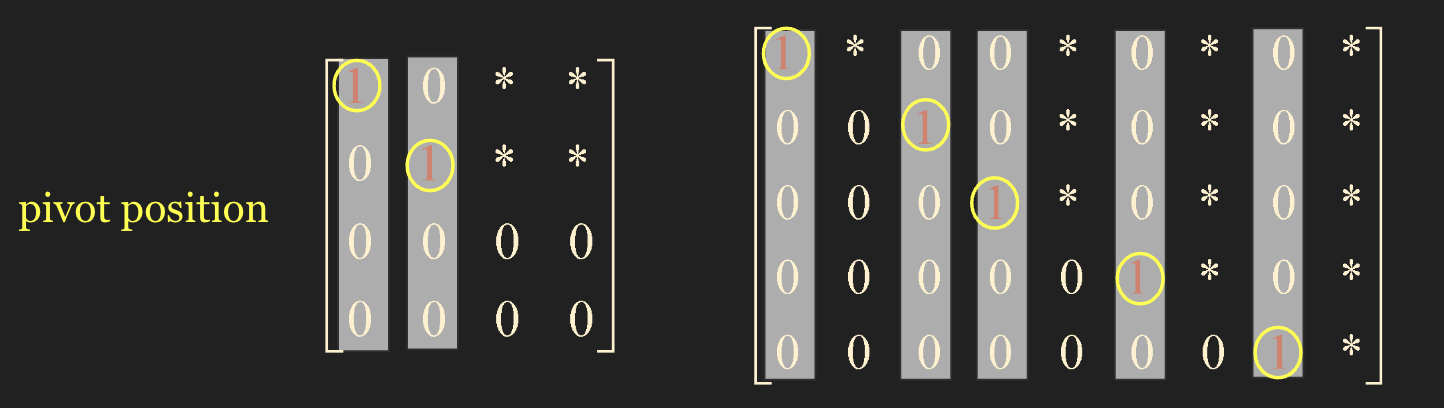
- The leading entry in each nonzero row is 1.
- pivot position : leading entry 1의 위치. pivot position은 reduced echelon form이 아니라 echelon form만으로도 확인할 수 있다.
Theorem1. Uniqueness of the Reduced Echelon Form
Each matrix is row equivalent to one and only one reduced echelon matrix.
- Theorem1. Uniqueness of the Reduced Echelon Form
- Each matrix is row equivalent to one and only one reduced echelon matrix.
- 각 매트릭스는 Reduced Echelon Form 이 딱 하나 밖에 없다. row reduction을 통해 row equivalent 를 얻을 수 있음
Row reduction algorithm - 행 줄임 알고리즘
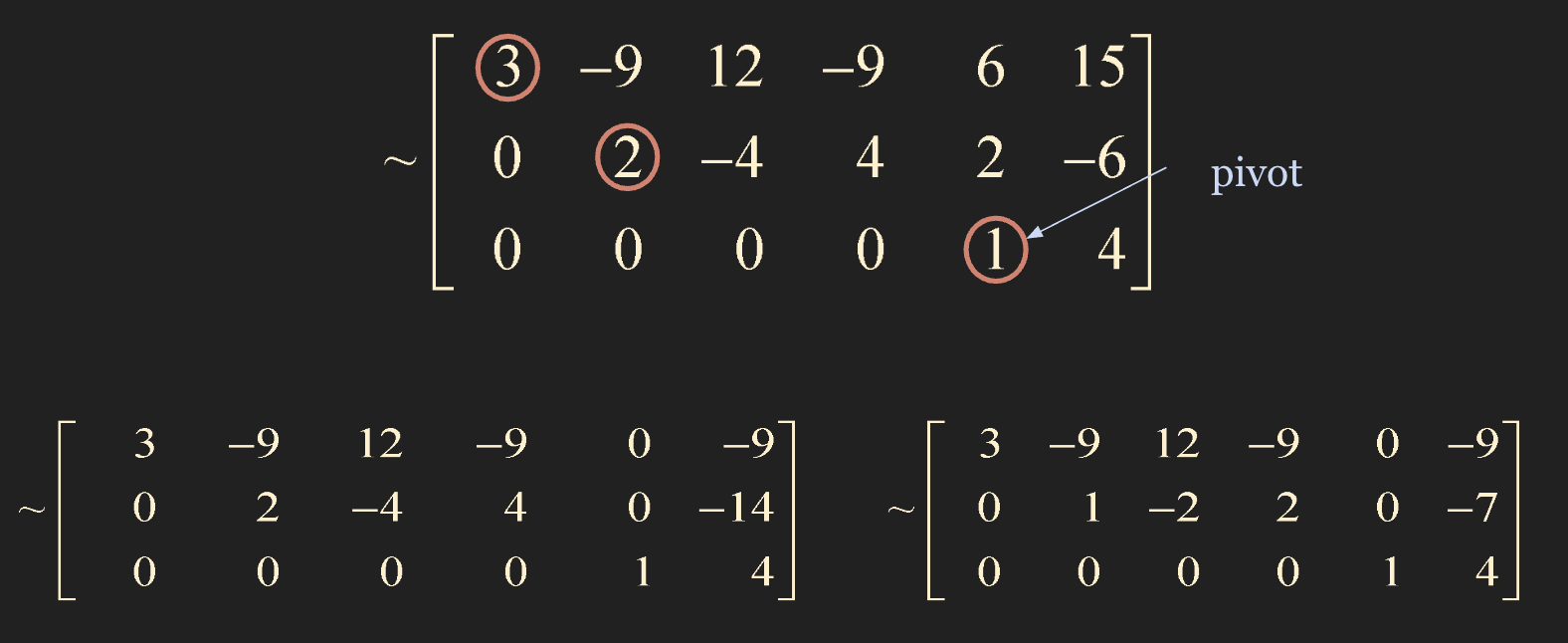
Step1. begin with the leftmost nonzero column
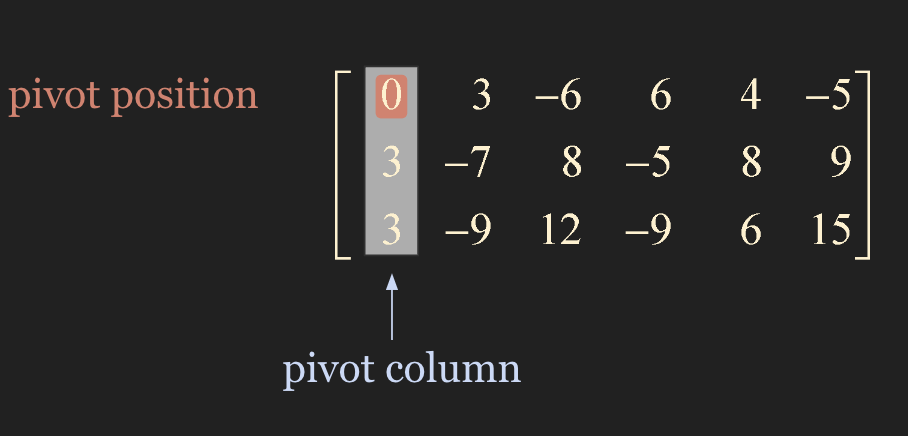
Step2. select a nonzero entry in the pivot column as a pivot. If necessary, interchange rows to move this entry into the pivot position
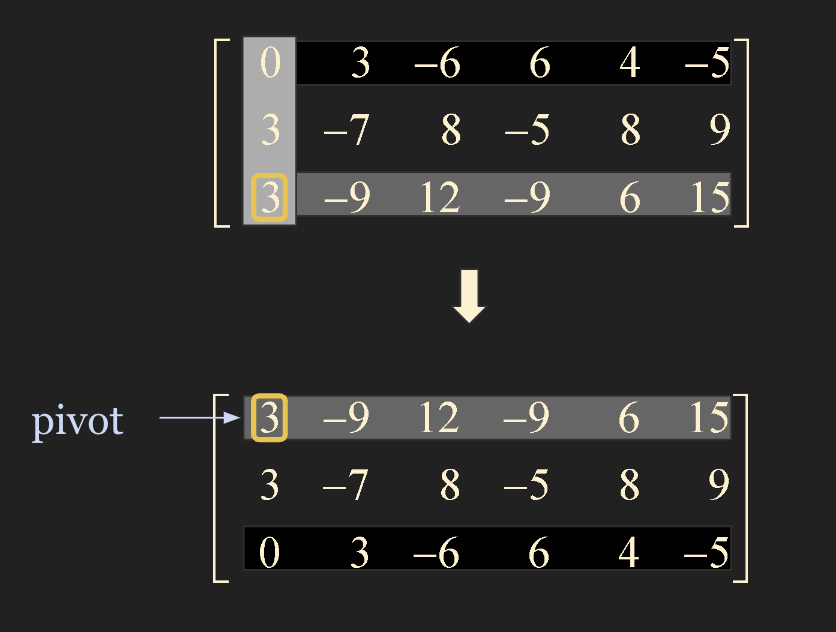
- pivot position 이 0이 되면 안되므로 interchange를 통해 row 를 바꿔주자.
Step3 row replacement to create zeros in all positions below the pivot
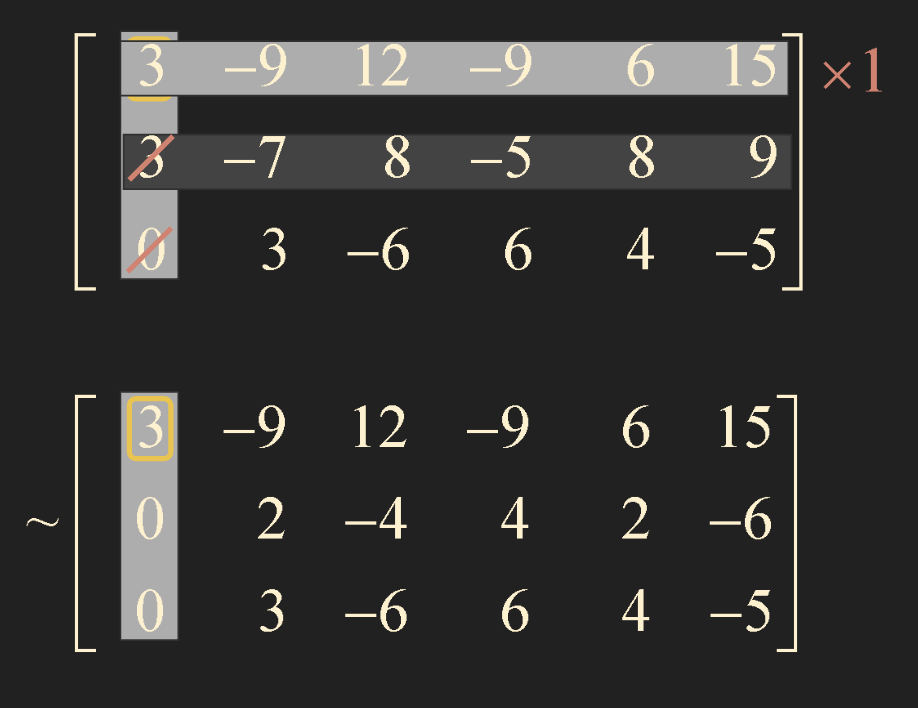
- pivot position을 제외한 pivot column에 있는 나머지들을 전부 0으로 만들어주기
Step4 apply steps 1-3 to the submatrix that remain
남은것에 대해 step 1-3 반복 수행
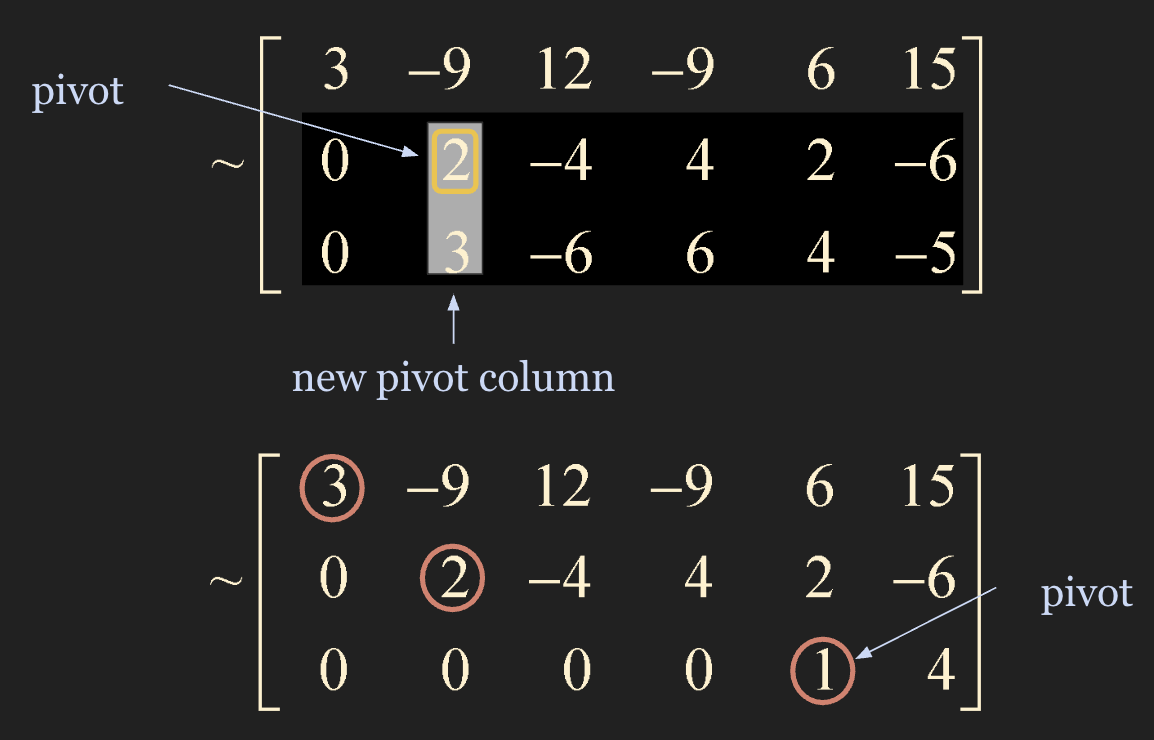
~ 표시는 row equivalent 하다는 뜻, 즉 row reduction을 통해서 얻을 수 있다.
- The combination of steps 1-4 is called forward phase
- 이 결과물이 -> echelon form! 이다
- 이 echelon form을 reduced echelon form 으로 만드는 것은
Step5 Beginning with the rightmost pivot and working upward and to the left, create zeros above each pivot.
If a pivot is not 1, make it 1 by a scaling operation.
맨 오른쪽에 있는 pivot 부터 이번에는 위에 있는 것들을 전부 0으로 만들어준다.
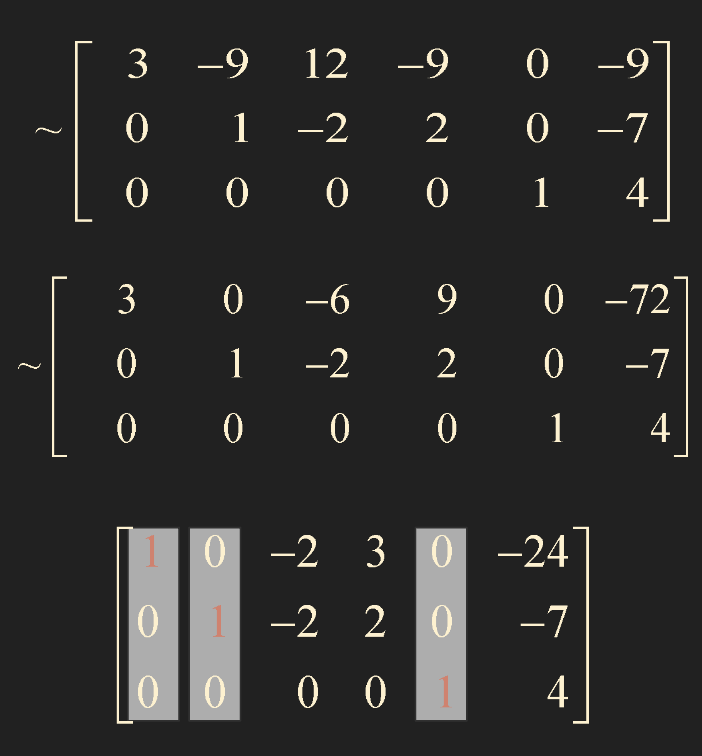
- Step 5 is called backward phase
- 이렇게 backward phase 까지 진행했으면 reduced echelon form 이 나온거고 이를 통해 솔루션을 얻을 수 있다.
Solution of linear systems - 선형 시스템의 해
- augmented matrix 를 row reduction 알고리즘으로 reduced echelon form을 만들면 선형방정식의 해를 쉽게 구할 수 있다.
- row reduction 으로 구한 reduced echelon form 형태의 augmented matrix
- 이를 linear equation 으로 표현해보자.
- 위 linear equation의 해를 구하면 다음과 같다.
- 여기서 중요한 것은 general solution (일반 해), basic variable (기본 변수), free variable (자유 변수) 가 무엇인지 확실하게 짚고 넘어가야 한다.
(1) free variable - 자유 변수
\[x_3 \; is \; free\]- $ x_3 $ 을 free variable 이라고 한다.
- $ x_3 $ 을 어떤 값으로 두어도 0 = 0 을 만족한다.
(2) basic variable - 기본 변수
- basic variable 은 free variable 로 표현한 것을 의미
(3) general solution - 일반 해
\[\begin{cases} x_1 = 1 + 5x_3 \\ x_2 = 4 - x_3 \\ x_3 \; is \; free \end{cases}\]general solution 은 basic variable 과 free variable 로 표현된 해를 의미한다.
- 해가 무한대로 존재한다. 이럴 때는 $x_3$라는 것을 free variable 으로 둔다.
- $x_1, x_2, x_3$ 이 중 어떤것이든 free variable 로 하지 않고 $x_1, x_2$ 같이 leading variables 에 포함되는 변수들을 basic variables로 잡고
- $x_3$를 free variable 로 정하기로 약속.
- 이런식으로 표현된 솔루션을 -> general solution
find the general solution of the following augmented matrix - augmented matrix 에서 general solution 찾기
- augmented matrix 를 row reduce
- backward phase 를 통해 0으로 만들고 row reduction 진행
- 여기서 leading variable에 해당되는것은 $x_1, x_3, x_5$ 이고 free variable은 $x_2, x_4$이다.
- reduced echelon form 을 linear equation 으로 표현한다.
- general solution 을 다음과 같이 표현할 수 있다.

만약 augmented matrix의 마지막 행이 $ [0 \quad 0 \quad 0 \quad 0 \quad 0 \quad \quad b] $ (b ≠ 0) 형태였다면 $ 0 = b $ 라는 모순이 발생하여 inconsistent, 즉 no solution이 된다.
Theorem2. Existence and Uniqueness Theorem
A linear system is consistent if and only if the rightmost column of the augmented matrix is not a pivot column - that is, if and only if an echelon form of the augmented matrix has no row of the forms.
\(\begin{bmatrix} 0 & \cdots & 0 & b \end{bmatrix} \quad\) with $ \; b \; $ is nonzero
If a linear system is consistent, then the solution set contains either (i) a unique solution, when there are no free variables, or (ii) infinitely many solutions, when there is at least one free variable.
- 이를 정리하자면 다음과 같다.
- linear equation 이 consistent 하면 augmented matrix에서 b가 pivot position이 아니다.
- 즉, b를 제외하고 0인 행렬이 있으면 안된다.
반대로, 0 & \cdots & 0 & b 인 row 가 있으면 -> no solution 이다.
- linear system 이 consistent 하면, (i) free variable 이 없다면 exactly one solution (unique solution) 이다.
- (ii) 1개 이상의 free variable 이 있다면 infinitely many solutions 이다.
- 즉, 해가 1개 -> free variable 이 존재하지 않고 해가 무수히 많다면 -> at least one free variable 이 존재한다.
예제 더 풀어보기
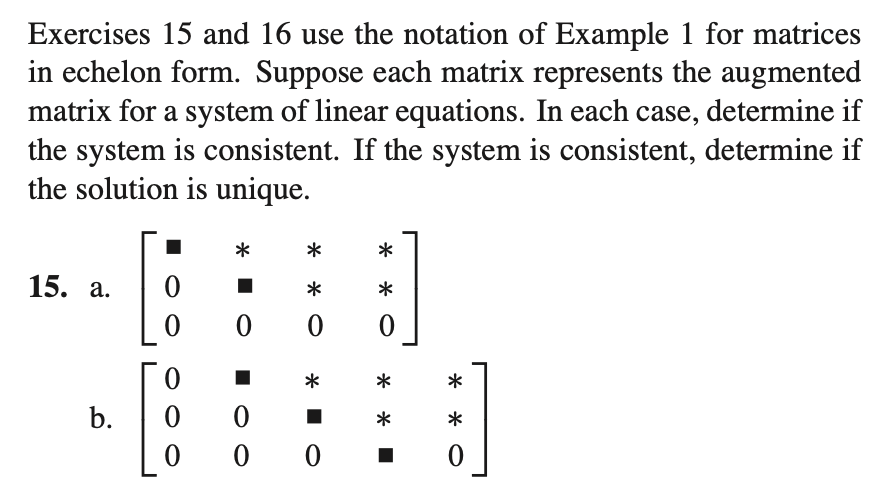
- a. 는 $ x_3 $ 가 free variable 이므로 consistent, many solutions 이다.
- b. 는 첫번째 column 이 전부 0 이므로 $ x_1 $ 이 free variable 이 되므로 consistent, many solutions 이다.